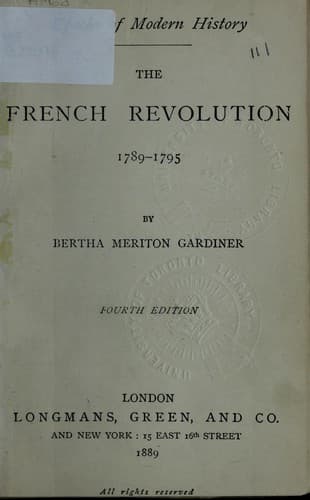
The French Revolution 1789-1795Gardiner, Bertha Meriton
History
The French Revolution 1789-1795
Gardiner, Bertha Meriton
France -- History -- Revolution, 1789-1799
The men who approved these acts and took part in them formed but an
exceedingly small minority in the departments--in some districts
so small that they might be counted on the fingers. In parts of
Brittany fugitive Vendeans, in the neighbourhood of Bordeaux fugitive
Girondists, remained in safe hiding, because there was no one who
cared to betray them. In the Basses Pyrénées, up till the autumn of
1793, revolutionary laws had remained unenforced, and a noble, elected
in 1790, was still mayor of Pau. The judges of the ordinary courts,
though at peril of their lives, refused to condemn their neighbours
to death. The mass of municipal and administrative officers only
took part in revolutionary measures under compulsion. A small knot
of men, cowards, ruffians, fanatics, and fortune-hunters, gathered
round the deputy in mission, directed the action of the clubs, sat in
the revolutionary committees, and were judges in the revolutionary
courts. Peasants and artisans gave as little active support to the
Terror as the nobles or the bourgeoisie. The peasants, having freed
themselves from feudal duties, became conservative. The requisitions
for the armies and the corn maximum were incessant causes of irritation
to them. The maximum of wages irritated artisans. Both classes were
alienated by the suppression of the Catholic worship. The Hébertists
vainly strove to acquire support by holding up the rich to reprobation,
and by undertaking to give provision to the poor, and to provide
labour for them. They succeeded in ruining the rich, but failed to
benefit the poor. The main object, with a view to which their whole
conduct was regulated, was to lay hands on all the wealth which tyranny
and brutality could bring within their grasp; and of the spoils the
larger part stayed, if not in their own hands, in the hands of their
agents--the smaller was spent in the public service, and a bare
pittance was left for providing bread and alms for the destitute.
Thus, in 133 districts, where 1,400,000_l._ were admittedly raised in
revolutionary taxes, a year afterwards only 430,000_l._ were accounted
for. Material want was far greater than in the capital. In Lyons,
Bordeaux, and many other places the inhabitants were put on rations,
and a few ounces of bad bread were daily doled out per head.
CHAPTER VIII.
THE FALL OF THE HÉBERTISTS AND DANTONISTS.
♦The Army.♦
Public-domain text, read in full here on John Shaqi.
Reviews
Reviews
No reviews yet
Be the first to share your thoughts on this work.
Elsewhere in the archive
Join the Discussion
Join the discussion
Sign in to leave a comment or review.
Sign InorCreate an account