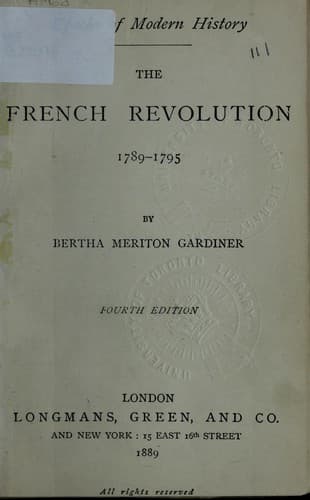
The French Revolution 1789-1795Gardiner, Bertha Meriton
History
The French Revolution 1789-1795
Gardiner, Bertha Meriton
France -- History -- Revolution, 1789-1799
While the internal condition of France was such as has been described,
her enemies were being successfully held in check on the frontiers.
After the great conscription decreed by the Convention in August had
been effected, there were in all some million of men in arms. The
nation might hate and despise its fanatic, tyrannical, and cruel
Government, but it none the less remained proud of the changes which
the revolution had effected, and was ready to endure the heavy yoke
laid on it for the sake of defending France against interference from
abroad. The nation was in reality far more truly represented by the
army than by the Government. The soldiers, like the mass of those
who stayed at home, were intensely enthusiastic in defence of their
country, but took no part in the strife of internal factions. The
Government was fully alive to the fact that it had not, except in a
passive sense, the support of the large forces which necessity had
compelled it to bring together, and the leaders in Paris lived always
with the fear before them that some general would follow the example
of Dumouriez, and turn against his employers. The Hébertists sought
to weed out of the army all officers who by birth belonged to the old
nobility. Such were cashiered by hundreds, and their places given to
men from the ranks. Even these new officers, however, became objects of
suspicion if they displayed military capacity, and won the affection
of their men; and the generals were on the merest pretext condemned
of treachery or treason by the revolutionary court, and were sent to
the scaffold. Deputies in mission acted as spies on the conduct of all
superior officers, reported their words and actions to the Committee
of Public Safety, attended at military councils, and were held by
the soldiers in more awe than the commander-in-chief. All the more
important movements of the armies were directed from Paris, where the
plans of campaigns were laid down by Carnot, one of the members of the
Committee of Public Safety. Carnot had been educated as a military
engineer, and his considerable abilities were made available by his
indefatigable energy and his intense enthusiasm for his work. In the
face of the many obstacles which the disorganisation of the Government
presented, he devoted himself entirely to the task of organising the
armies, and of insuring that the war which extended over so wide a
field should be conducted with intelligence and method. The success
which the French attained was undoubtedly in great part owing to his
unremitting exertions. Hitherto the army had been divided into two
bodies, distinguished from one another by pay, uniform, and system of
advancement--namely, troops of the line which had formed the army of
the monarchy, and new battalions raised since the beginning of the war.
♦The French Army.♦ In February 1793, the Convention had determined
to abolish these distinctions, and to fuse in common regiments the
Public-domain text, read in full here on John Shaqi.
Reviews
Reviews
No reviews yet
Be the first to share your thoughts on this work.
Elsewhere in the archive
Join the Discussion
Join the discussion
Sign in to leave a comment or review.
Sign InorCreate an account