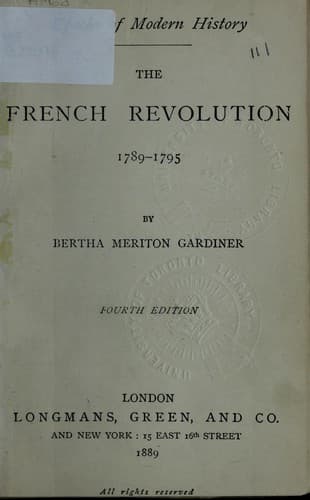
The French Revolution 1789-1795Gardiner, Bertha Meriton
History
The French Revolution 1789-1795
Gardiner, Bertha Meriton
France -- History -- Revolution, 1789-1799
By the side of the two committees of Government, the Committee of
Finance occupied an important and, to some extent, an independent
position. The Committee of Public Safety possessed no member prepared
to undertake the direction of the finances, and it was therefore
obliged to leave the initiative to others. The deputy Cambon, who sat
on the confines of the Mountain, practically occupied the position of
Minister of Finance; and several laws introduced by him were adopted,
designed to restore equilibrium between expenditure and revenue, and
to prevent increase in the number of assignats in circulation. The
State possessed a large number of creditors, some lenders before the
revolution, others since; whilst to others compensation was due for
abolished offices. All these creditors were put on the same footing.
Capital, if due to them, was made irrecoverable, and in all cases five
per cent. interest given. The old titles were destroyed and the new
entered in a common book, called the Great Book of the Public Debt.
The State gained by the operation, more especially in the case of
loans contracted before the revolution, often on very onerous terms. A
new source of revenue was sought in the imposition of a forced loan,
according to the law passed in the spring. The lenders were to be
repaid in confiscated lands. This loan was expected to bring in the
large sum of 43,750,000_l._, and assignats to that amount were to be
withdrawn from circulation.
Efforts to restore the finances were, however, as fruitless as efforts
to advance education. While millions were being squandered in the
departments, taxes imposed by the Convention remained unpaid. The
forced loan never brought in more than eight millions. Cambon vainly
reiterated complaints that but little of the sums irregularly raised
in the departments ever reached the treasury. So long as the Commune
exercised power, it was impossible for the Convention to take any
effectual steps for the enforcement of its decrees.
Public-domain text, read in full here on John Shaqi.
Reviews
Reviews
No reviews yet
Be the first to share your thoughts on this work.
Elsewhere in the archive
Join the Discussion
Join the discussion
Sign in to leave a comment or review.
Sign InorCreate an account