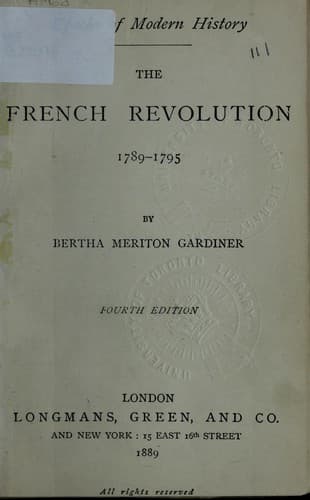
The French Revolution 1789-1795Gardiner, Bertha Meriton
History
The French Revolution 1789-1795
Gardiner, Bertha Meriton
France -- History -- Revolution, 1789-1799
The Constituent Assembly had retained, until the proprietors could be
compensated, feudal duties presumed to be due for a grant of land. The
Legislative Assembly, following a theory which had been entertained by
many lawyers--that land was originally free--had decreed the abolition
of all duties without indemnity, except in cases where the proprietors
could prove the original title, showing that the duties were really
due for a grant of land. This as a rule was impossible, the duties
being due by prescription only. The new law gave rise to suits, and
the Convention destroyed the last vestiges of the feudal system by
decreeing the abolition without indemnity of all duties which bore a
feudal character. Before the ejection of the Girondists entails were
abolished, and parents were also prohibited from making wills favouring
one child more than another. Parents were now further prohibited from
giving more than a tenth of their property to strangers, or more than
a sixth to collateral relations. Illegitimate children were put on the
same footing as legitimate. The Legislative Assembly had instituted
civil marriages, and had permitted divorce, on the mere ground of
incompatibility of temper, with the consent of both parties. A new
civil code, clear and simple, and in accordance with the legislation
of the revolutionary Assemblies, was being prepared to take the place
of the chaos of old laws and customs. The work, however, was but in
progress, and the new code was not promulgated by the Convention. Negro
slavery was abolished, and men of colour in the colonies received the
rights of French citizens. A decree was passed for the establishment
of primary schools to be maintained by the State. Instruction was
to be gratuitous, attendance compulsory, and no religious teaching
allowed. Laws were also passed for the institution of three schools
of medicine and a school of natural history at Paris. But little was
in reality effected for the instruction of any class. Money and power
were both wanting. Instigated by its Committee of Public Instruction,
the Convention repeatedly ordered the preservation of the valuable
monastic libraries. None the less, the books were neglected, plundered,
and scattered. Primary schools, if opened, were, in the country,
unattended. Of higher education little was to be had. Suspected of
reactionary tendencies, all academies and learned societies had been
broken up. Most colleges had disappeared; a few dragged on a feeble
existence.
♦Cambon’s financial measures.♦
Public-domain text, read in full here on John Shaqi.
Reviews
Reviews
No reviews yet
Be the first to share your thoughts on this work.
Elsewhere in the archive
Join the Discussion
Join the discussion
Sign in to leave a comment or review.
Sign InorCreate an account