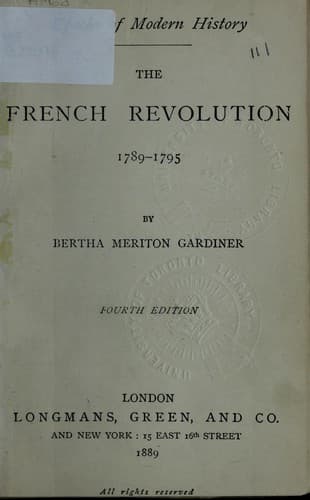
The French Revolution 1789-1795Gardiner, Bertha Meriton
History
The French Revolution 1789-1795
Gardiner, Bertha Meriton
France -- History -- Revolution, 1789-1799
Thus, both by principle and ambition, Robespierre was urged on to seek
the destruction of the Hébertists and of the Commune. His colleagues
on the two committees, though most of them disliked him personally,
and were afraid of his gaining increased ascendancy for himself,
shared his desire to break the power of the Commune. As they grew more
accustomed to the exercise of authority, they became impatient at
having to share it with a body whose will had always to be taken into
consideration, and by whose action their own was often thwarted. The
Montagnards hated the tyranny of the two committees, but they hated
the tyranny of the Commune yet more, and were willing to take part in
overthrowing it, neglectful of the probability that by so doing they
would yet more securely rivet the chains in which the committees held
them. In the Convention the Hébertist generals and agents in La Vendée
were incessantly accused of misconduct and incapacity, and of being
responsible for whatever reverses had taken place. A law was passed
intended to centralise power in the hands of the two committees, and
to deprive the Commune of the instruments by means of which it secured
ascendancy in the departments. The revolutionary committees of Paris
were put under the supervision of the Committee of General Security.
The Commune was deprived of the right of sending agents into the
departments. The revolutionary army of Paris was for the time left in
existence, through fear lest if an attempt were made to disband it, it
might rise against the Convention, but the revolutionary armies in the
departments were to be suppressed. No taxes were to be imposed without
the sanction of the Convention. The law officers belonging to districts
and municipalities, hitherto elected, were made dependent on the
central Government, and received the name of national agents (December
4).
♦Struggle between Dantonists and Hébertists.♦
Public-domain text, read in full here on John Shaqi.
Reviews
Reviews
No reviews yet
Be the first to share your thoughts on this work.
Elsewhere in the archive
Join the Discussion
Join the discussion
Sign in to leave a comment or review.
Sign InorCreate an account