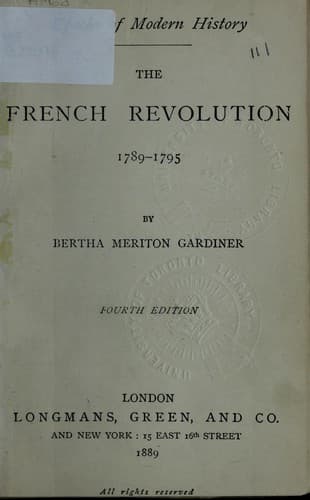
The French Revolution 1789-1795Gardiner, Bertha Meriton
History
The French Revolution 1789-1795
Gardiner, Bertha Meriton
France -- History -- Revolution, 1789-1799
About the same time that this law was adopted, Desmoulins, encouraged
by Robespierre, began the publication of a paper, the _Old Cordelier_,
in which he first confined himself to denouncing the Hébertists, but
went on to denounce the Terror itself as a great deception, and to
compare the state of things in France to that which prevailed under
the worst of the Roman emperors. The law of treason, he said, was
extended to words; the inhabitants of towns were killed in masses.
Grief, pity, looks of disapprobation, silence itself, constituted State
crimes. It was a crime to be rich; a crime to give shelter to a friend.
Is it possible, he asked, that the state of things which constituted
despotism and the worst of governments when Tacitus wrote, constitutes
to-day liberty and the best of possible worlds? You wish to exterminate
your enemies by the guillotine. What folly! For every man you kill you
make ten new enemies. If we do not understand by liberty the carrying
out of principles, never was there an idolatry so stupid as ours, nor
one that costs more. Liberty is no operatic singer promenading in a red
cap. Liberty is happiness, equality, justice, the Declaration of Rights
itself. If I am to recognise her presence, open the prison doors to
those 200,000 citizens whom you call ‘suspected.’
Thus was the Commune attacked on three sides at once--by Montagnards,
who desired the independence of the Convention; by the Committee of
Public Safety, which sought the extension of its own authority; and by
Dantonists, who sought to hold in check the Terror. Hébert was afraid
to enter into contention with Robespierre. By the atheistic movement
he had sought and attained notoriety, but its active supporters were
few, and there was no probability that any considerable body of men
would rally round him in its defence. Chaumette, at the Commune, made
a speech on the folly of attempting to suppress religious opinions by
force. Hébert went further, and made a formal denial of atheism at the
Jacobins. But while seeking to curry favour with Robespierre, Hébert
and his followers opened the more vehement attack on the Dantonists.
Here they were surer of their ground, for all who had been actively
engaged in the work of destruction dreaded the first step of reaction,
lest vengeance should overtake themselves. The Cordeliers erased the
names of Danton and Desmoulins from their list of members. Collot,
the director of the atrocities committed at Lyons, who had returned
to Paris in December, expressed amazement that the first who spoke of
clemency had not been sent to the scaffold. Amongst the twelve men who
formed the Committee of Public Safety no good understanding existed.
Six concerned themselves with special branches of administration, but
took no part in directing the general action of the Government. The
remaining six were not all of one mind. Couthon and St. Just were
devoted adherents of Robespierre. Barère, originally a deputy of the
Public-domain text, read in full here on John Shaqi.
Reviews
Reviews
No reviews yet
Be the first to share your thoughts on this work.
Elsewhere in the archive
Join the Discussion
Join the discussion
Sign in to leave a comment or review.
Sign InorCreate an account