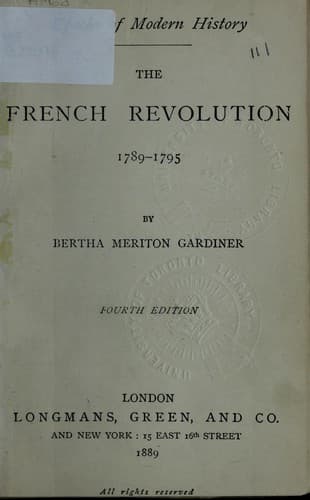
The French Revolution 1789-1795Gardiner, Bertha Meriton
History
The French Revolution 1789-1795
Gardiner, Bertha Meriton
France -- History -- Revolution, 1789-1799
Behind Robespierre was St. Just, a young man a little over twenty,
fanatic, self-confident and intolerant. In thought he was more
audacious than Robespierre, and his conceptions were more definite. He
was probably the most thorough-going disciple of Rousseau in France.
Like his master, he based his conceptions of what the government of
a great state ought to be on the institutions of the petty republics
of antiquity, and of all those republics the one which he selected
for imitation was, strangely enough, that of aristocratic Sparta.
But it was the despotism of Sparta, not its aristocracy, which he
admired. By means of Spartan institutions he thought to remould the
habits and customs of his countrymen. All boys were to be brought up
together in common schools. Every man was to marry, and every man to
work. Every man was to have friends, and to make every year a public
declaration of their names in the temple of the Supreme Being. If he
committed a crime, his friends were to be banished from the Republic.
In short, by aid of laws and state institutions of this character,
St. Just believed it possible to give to the French people simple,
frugal, and industrious habits. Circumstances, he said, were of
no importance, except to men who fear death. Meanwhile, until the
necessary institutions should be established and the habits and beliefs
of his countrymen transformed, St. Just, like Robespierre, fell back
on the guillotine in order to get rid of those who stood in the way of
the accomplishment of his ideal. Until men were virtuous in his sense
of the word, the Republic could rest upon terror alone. What, asked
this young, fanatical, and unscrupulous theorist, would those have who
reject alike as principles of government virtue and terror?
Besides fanaticism and love of power, there existed a material motive
for the continuance of the Terror. Resources were secured for the
service of the State. As soon as a person was imprisoned his capital
was sequestered and his revenue confiscated. When he was condemned
to die, the capital itself was confiscated. But the promise held out
before the arrest of the Hébertists, that provision should be made
for the indigent out of sequestered property, was never carried into
effect. Further, purchasers of state lands lost their lives by scores,
and thus national property came a second time into the market as
security for the paper money. Cynical words ascribed to Barère exactly
expressed the satisfaction felt by many at these financial results of
the guillotine. ‘We coin money,’ he was reported to have said, ‘on the
Place de la Révolution.’
Public-domain text, read in full here on John Shaqi.
Reviews
Reviews
No reviews yet
Be the first to share your thoughts on this work.
Elsewhere in the archive
Join the Discussion
Join the discussion
Sign in to leave a comment or review.
Sign InorCreate an account