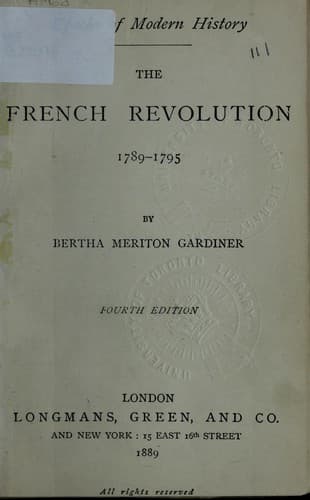
The French Revolution 1789-1795Gardiner, Bertha Meriton
History
The French Revolution 1789-1795
Gardiner, Bertha Meriton
France -- History -- Revolution, 1789-1799
Reports of the execution of the Hébertists penetrated the prison
walls, and aroused hope that the Terror itself was to come to an end.
Such hopes rapidly proved delusive. The dictatorship of the Committee
of Public Safety, founded by terror, rested on terror alone. Collot
and Billaud had no other thought than to perpetuate their rule by
continuing the system already in force. Robespierre was equally cruel,
not, as in their case, from mere disregard of the amount of blood
shed, but because he aimed at more, and regarded the guillotine as the
most facile instrument for the attainment of his ends. He could not be
satisfied with that which satisfied Billaud and Collot. Already the
most prominent man on the committee, he sought the first place in the
Republic, and to figure before Europe as the maintainer of virtue and
the regenerator of his country. He had learned of Rousseau to regard
as utterly hateful the state of society in the midst of which he had
grown up with its division of classes and glaring contrasts between
knowledge and ignorance, indolence and toil, luxury and squalor. Had
the power been his, he would have destroyed every vestige of it by
fusing all classes into one, abolishing vice and ignorance, with the
extremes of wealth and poverty, and giving to all citizens similar
interests, habits and pleasures. This ideal, which was Rousseau’s,
was always present in Robespierre’s mind, veiling from him his own
ambition; but it was vague, and he had no definite conception of
the manner in which its realisation should be attempted. He was not
a thinker or an organiser. Rousseau had suggested education and
legislation as possible means of regeneration. To these Robespierre
added nothing but the guillotine, the principle of extermination of
opponents. All who stood in his light he proscribed one after another,
as they appeared before him--the noble, the capitalist, the merchant,
the free-trader, the atheist, the fanatic, the merciful, the moderate,
the corrupt, the extortionate, and even the neutral man, until at last
the people whose praises were constantly on his lips dwindled down in
his mind to be no more than the Robespierrists, a few hundred ignorant
and credulous but fervent supporters and admirers.
♦St. Just.♦
Public-domain text, read in full here on John Shaqi.
Reviews
Reviews
No reviews yet
Be the first to share your thoughts on this work.
Elsewhere in the archive
Join the Discussion
Join the discussion
Sign in to leave a comment or review.
Sign InorCreate an account