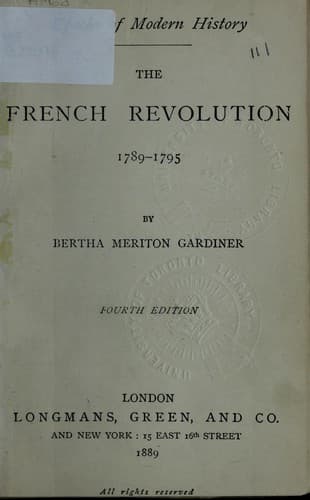
The French Revolution 1789-1795Gardiner, Bertha Meriton
History
The French Revolution 1789-1795
Gardiner, Bertha Meriton
France -- History -- Revolution, 1789-1799
Upon the destruction of the dictatorship of the committees, supreme
power reverted to the Convention. That body, however, had as little
coherence now as it had had in the first months of its existence. The
restitution of its liberty split it into numerous sections. It was
torn by violent party spirit, and had no determinate policy or aim,
but drifted onwards, following not directing the course of events.
All agreed in condemnation of Robespierre, but in that alone. The
Montagnards were divided amongst themselves. Only a small minority
was prepared to maintain in its entirety the Terror as a system
of government--Billaud and Collot and their companions in office,
who feared for their own lives. A few, such as Romme and Soubrany,
resolutely opposed social and economical changes which would, in the
end, lead to the return of the middle-class to power. Others again,
as the financier Cambon and the Dantonist Thuriot, struggled to
maintain the ascendancy of the Mountain over the Plain, but declared
war on Billaud and Collot, who, following in the course of Hébert and
Robespierre, sought, by aid of clubs and revolutionary committees,
to tyrannise over the Mountain. The Thermidorians, so-called from the
name of the revolutionary month in which the new revolution had been
effected, Tallien, Fréron, and others of the men who had conspired to
destroy Robespierre, took up a position between the Mountain and the
Plain, and for the time possessed the leadership of the Convention;
but they had no policy except that of yielding sufficiently to public
opinion to maintain ascendancy, and at the same time of holding in
check the reaction so as to prevent its reaching themselves. One after
another demands made by the anti-Terrorist press and by gatherings
in the Palais Royal were complied with. The Jacobin Club, the resort
of Collot, Billaud, and their partisans, was closed (November 12).
The Revolutionary Committees were reduced in number and shorn of
their powers. Thousands of prisoners were released and their property
restored to them. Throughout the country new men were placed in office,
while members of revolutionary committees and other inferior tools of
the Terror were imprisoned by hundreds. A trial going on before the
Revolutionary Court at Paris revealed in all their horrible details the
massacres committed at Nantes, and raised a cry for vengeance against
Carrier. Abandoned by the Thermidorians and almost the entire Mountain,
Carrier was sent before the court for trial, and thence in his turn to
the scaffold (December). Billaud, Collot, and other marked Terrorists,
already denounced in the Convention by Danton’s friends, felt that
danger was every day drawing nearer to themselves. Their fate was to
all appearance sealed by the readmission to the Convention (December 8)
of seventy-three deputies of the right, imprisoned in 1793 for signing
protests against the expulsion of the Girondists.
Public-domain text, read in full here on John Shaqi.
Reviews
Reviews
No reviews yet
Be the first to share your thoughts on this work.
Elsewhere in the archive
Join the Discussion
Join the discussion
Sign in to leave a comment or review.
Sign InorCreate an account