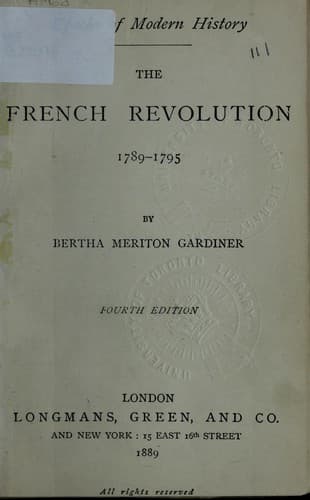
The French Revolution 1789-1795Gardiner, Bertha Meriton
History
The French Revolution 1789-1795
Gardiner, Bertha Meriton
France -- History -- Revolution, 1789-1799
It is calculated that during the fourteen months which had elapsed
since the ejection of the Girondists, about 16,000 persons had perished
throughout France by the sentence of revolutionary courts. With the
proscription of the Robespierrists the Terror as a system of government
came to an end. Collot and Billaud, in overthrowing Robespierre, had
deprived themselves of the two main engines by which the machinery of
the Terror had been kept in motion. After the execution of its members
the Commune had been broken up, and the Jacobins were enfeebled. The
Mountain at once asserted its independence of the two committees; the
Plain, in turn, asserted its independence of the Mountain. From this
time the committees were renewed by a fourth every month, and the
outgoing members rendered incapable of immediate re-election. Within a
few weeks all the men who conducted the Government during the Terror
had resigned or had been deprived of office.
The fall of Robespierre and of the committees was felt as much in
Paris as it was in the Convention. No sooner did the incessant action
of the guillotine cease than the revolutionary authorities fell into
contempt, and the revolutionary laws, which the Terror alone had
sustained, ceased to be observed. There was again freedom of action, of
speech, and of the press. Hundreds and thousands of young men collected
in the sections and public places, declaring war on the Jacobins,
and demanding the release of friends and relations, the abolition
of revolutionary committees, the imprisonment and trial of their
late oppressors. They belonged to all ranks of life, but were mostly
skilled artisans, clerks in offices, shopmen, tradesmen, and sons of
nobles and capitalists. As in 1789, the agitation had its centre in
the Palais Royal, and, as then, found its leaders in young authors
and journalists. In the departments the reaction proceeded with equal
rapidity. Nowhere was any attempt made to resist the new revolution.
The names of Robespierre and Couthon were given over to execration by
the same men who a week before had made a show of delight in honouring
them. The petty tyrant of yesterday, ejected from office, went to join
his victims in prison; and, as in Paris, all classes of the population
speedily took advantage of the relaxation of the Terror to slip their
necks free of the yoke of the revolutionary laws.
Public-domain text, read in full here on John Shaqi.
Reviews
Reviews
No reviews yet
Be the first to share your thoughts on this work.
Elsewhere in the archive
Join the Discussion
Join the discussion
Sign in to leave a comment or review.
Sign InorCreate an account