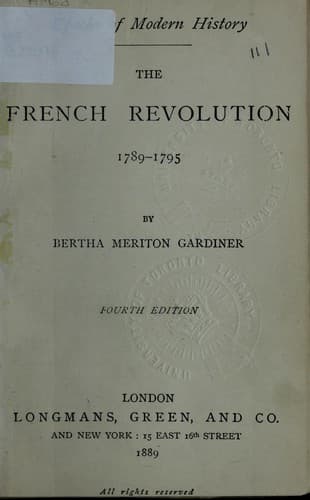
The French Revolution 1789-1795Gardiner, Bertha Meriton
History
The French Revolution 1789-1795
Gardiner, Bertha Meriton
France -- History -- Revolution, 1789-1799
lived on wages were seriously affected. Wages had indeed risen, but not
in proportion to prices. Starvation prices prevailed. Workmen earned
from five to eleven shillings a day in paper money, while a multitude
of State officials, pensioners and creditors, received no more than
from three to six shillings a day. Yet at this time a pound of bread
cost eight shillings, of rice thirteen, of sugar seventeen, and other
articles were all proportionately dear. It is literally true that more
than half the population of Paris was only kept alive by occasional
distributions of meat and other articles at low prices, and the daily
distribution of bread at three-halfpence a pound. In February, however,
this source of relief threatened to fail. Farmers preferred to send
their corn anywhere else than to Paris, where only paper money was
to be had. It was only with extreme difficulty that the Government,
which since the annihilation of the Commune had supplied Paris with
bread, performed its task. The rations fell from one pound to half a
pound, and soon to a few ounces per head. Numerous deaths took place,
the result of destitution or actual starvation. An insurrection,
however, though constantly threatened, for weeks failed to break out.
One cause was that the people had grown hopeless of improving their
condition by insurrection; another, that those journalists, clerks,
and others, who at the opening of the revolution had incited popular
movements, were now, although suffering themselves, found on the
other side, and were prepared to fight in defence of the Convention,
which they none the less detested, sooner than endure a revival of
the Terror. Material suffering offered, however, a ready handle for
Terrorist agitators; and as the peril of insurrection increased, so
too, within the Convention, did the violence of party strife. The
Mountain, threatened with proscription, sought to turn the position of
the right and to obtain credit outside, by demanding the immediate end
of provisional government and the putting in force of the democratic
constitution promulgated by the Convention in 1793, after the ejection
of the Girondists. On April 1, or Germinal 12, bread riots, begun by
women, broke out in every section. Bands collected and forced their
way into the Convention, shouting for bread, but offering no violence
to the deputies. Occasionally the demand was made for the release of
imprisoned patriots and for the Constitution of 1793. The crowd was
already dispersing when forces arrived from the sections and cleared
the House. The insurrection was a spontaneous rising for bread, without
method or combination. The Terrorists had sought, but vainly, to obtain
direction of it. Had they succeeded, the Mountain would have had an
opportunity of proscribing the right. Their failure gave the right
the opportunity of proscribing the left. The transportation to Cayenne
of Billaud, Collot, Barère, and Vadier was decreed, and the arrest of
Public-domain text, read in full here on John Shaqi.
Reviews
Reviews
No reviews yet
Be the first to share your thoughts on this work.
Elsewhere in the archive
Join the Discussion
Join the discussion
Sign in to leave a comment or review.
Sign InorCreate an account