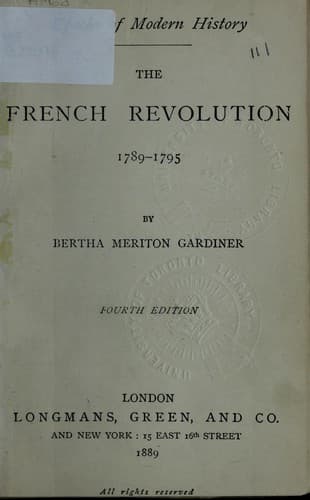
The French Revolution 1789-1795Gardiner, Bertha Meriton
History
The French Revolution 1789-1795
Gardiner, Bertha Meriton
France -- History -- Revolution, 1789-1799
fifteen other Montagnards, accused without proof, in several cases
without probability, of having been accomplices of the insurgents. The
Thermidorians showed themselves more vindictive than the Girondists,
and it was on the proposition of Tallien that amongst those proscribed
were included Thuriot and Cambon, men whose hands, compared with his
own, were clear of blood.
The insurrection of Germinal 12 gave increased strength to the party
of reaction. The Convention, in dread of the Terrorists, was compelled
to look to it for support. The bands of young men who assembled in the
Palais Royal, called ‘Fréron’s army,’ often rendered useful service by
clearing the Tuileries Gardens of discontented and threatening groups.
Already the dress, language, and manners in vogue during the Terror
were laid aside. Red caps gave place to hats. The habit of addressing
strangers by the familiar ‘thou,’ and the use of the word ‘citizen,’
were dropped in drawing-rooms. No Jacobin could set foot in the Palais
Royal without experiencing insults and blows. Busts of Marat, which had
been set up in every public building, were pulled down and broken, and
both theatres and streets became the scene of incessant riots.
♦Reaction in the Departments.♦
In the departments famine, disorder, and crime prevailed, as well as
in Paris. In all towns a large portion of the population was kept
alive by daily distributions of bread. The country was exhausted
by the war burdens laid on it. Requisitions for the armies had
drained one department after another of horses, carts, corn, and
men. Nevertheless, destitution was not so great in rural districts
as in towns. Corn growers, since the fall of Robespierre, had made
large profits, while every peasant sold his wine or other produce at
prices as high in proportion as the price of bread. From the first
the reaction proceeded in the departments with a more rapid step and
in bolder form than in Paris which was subjected to the restraining
influences exercised by the presence of the Convention. Everywhere,
except in Paris, municipal bodies had, as early as in January, suffered
churches to be reopened and Mass again to be celebrated. Without
the Terror it was as impossible to maintain the proscription of the
Catholic worship as it was to enforce the observance of maximum laws.
A minority in the Convention, composed of Catholics and Liberals,
desired to carry into practice those principles of religious toleration
which the Convention in theory had always maintained and had publicly
announced in opposition to Hébert, but which for so many months it had
neglected to put in practice. The majority, whatever their repugnance
to a revival of sacerdotal influence, recognised the hopelessness of
resisting the popular movement. Since the beginning of the Revolution
the idea of the separation of Church and State had gained ground. The
constitutional clergy desired to be allowed to reorganise the Church
without any interference by the State.
Public-domain text, read in full here on John Shaqi.
Reviews
Reviews
No reviews yet
Be the first to share your thoughts on this work.
Elsewhere in the archive
Join the Discussion
Join the discussion
Sign in to leave a comment or review.
Sign InorCreate an account