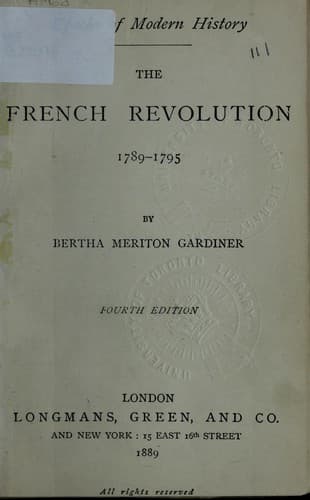
The French Revolution 1789-1795Gardiner, Bertha Meriton
History
The French Revolution 1789-1795
Gardiner, Bertha Meriton
France -- History -- Revolution, 1789-1799
Siéyès, Rewbel, and the other members of the Committee of Public
Safety, regarded these treaties with Prussia and Spain merely as
steps towards the final goal they had in view, namely, the conclusion
of a European peace ceding to France the Alps and the Rhine as her
boundaries. After making peace with Prussia and Spain, they hoped to
obtain the alliance of Prussia to aid them in crushing Austria in
Germany, and the alliance of Spain to aid them in crushing England at
sea. For the time, want of resources caused a practical cessation of
hostilities on the Upper Rhine. The Austrian armies on the right bank,
short of money and food, remained on the defensive. The French armies
on the left bank lived with difficulty at the cost of the conquered
territories, which, having long been the seat of war, were suffering
extreme misery. Meanwhile, the attention of the Government was drawn
towards the west, where war still smouldered in La Vendée, and where
a new war had broken out north of the Loire. In the large forests
and uncultivated tracts in which the provinces of Brittany, Maine,
and Anjou abounded, many bands of insurgents appeared, composed of
brigands, deserters from the armies, fugitive Vendeans, and returned
emigrants. They were called ‘Chouans,’ after one of their leaders,
a smuggler, who had himself received the nickname--derived from
‘chouette,’ a small owl--either from his surly, morose habits, or from
his using the owl’s cry as a signal. Though without organisation, and
under the conduct of a number of independent chiefs, the war proved
as difficult to suppress as the war in La Vendée. In the autumn of
1794 it spread into Normandy, and threatened to assume the form of a
general insurrection. The peasants, who resented the suppression of
their religion and the persecution of their priests, when they did
not join the marauders were in connivance with them. Raids were made
on republican posts, supplies cut off from towns, and many isolated
murders committed. In support of the movement, emigrants and priests
came from England, bringing with them munitions of war, and money both
in coin and forged assignats. So serious did the danger become, that
the Committee appointed Hoche, at this time the most distinguished
general whom the Republic possessed, to the command-in-chief of the
forces north of the Loire. During the Terror, his services to his
country had been requited by imprisonment, and but for Robespierre’s
sudden destruction, he would have fallen a victim to the guillotine.
Besides being an able soldier, Hoche was a sincere and patriotic man in
both public and private life, single-minded, straightforward, and pure.
The irksome and inglorious task now entrusted to him he carried out
with characteristic firmness and moderation, and while taking severe
measures for the repression of rebellion, he did all in his power to
win the good-will of the inhabitants, by treating them justly and
restoring discipline amongst his troops.
Public-domain text, read in full here on John Shaqi.
Reviews
Reviews
No reviews yet
Be the first to share your thoughts on this work.
Elsewhere in the archive
Join the Discussion
Join the discussion
Sign in to leave a comment or review.
Sign InorCreate an account