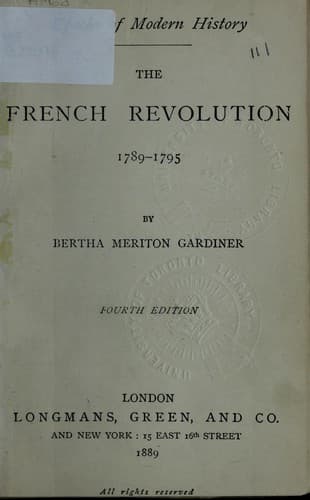
The French Revolution 1789-1795Gardiner, Bertha Meriton
History
The French Revolution 1789-1795
Gardiner, Bertha Meriton
France -- History -- Revolution, 1789-1799
He allowed the churches to be
reopened, and by leaving the clergy unharassed, sought to destroy their
enmity towards the Republic. Both the Convention and the insurgents
desired a breathing time in which to recruit their forces. Charette,
and other Vendean leaders, made an engagement to lay down arms and
recognise the authority of the Republic, on condition that indemnity
should be granted to themselves, that liberty of worship should be
allowed, and that the national guard should be under their command
(February 17). Many Chouan chiefs recognised the Republic on the same
terms (April 20). These agreements were merely armed truces. The
insurgent leaders retained their authority, and were but waiting the
arrival of means from England to resume their arms.
Fortunately for the Republic, its enemies were unready and disunited.
The concurrence of a general conflagration in the West, and of the
advance of 200,000 men across the Rhine, would have called to mind
the hazards run in 1793. Hostilities, however, still flagged on the
Rhine, while in the West jealousy and discord destroyed the chances
of successful resistance to the Republican armies. Amongst the
emigrants no union existed. Those who had fled in 1790 regarded with
contempt and aversion those who fled at a later date, and confounded
Constitutionalists with Robespierrists and Terrorists under the common
name of Jacobins. The leader of the expedition from England, Count
Joseph of Puisaye, was in ill-favour with the supporters of the Count
of Provence, because in 1789 he had been on the popular side. Hoche,
aware of their designs, arrested the Baron of Cormaton, the most
able of the Chouan chiefs, and seven other leading conspirators (May
15). The war in consequence was renewed in Brittany, but Charette,
who did not care to act as second to Puisaye, remained quiet in
La Vendée. The expedition from England disembarked at Carnac, the
little town at the head of the peninsula which encloses on one side
the Bay of Quibéron. Pitt had forborne to risk the lives of English
troops until assured that the emigrants were able, in accordance
with their representations, to acquire a firm footing in the country.
The force consisted of about 5,000 emigrants and between 1,000 and
2,000 French prisoners of war. Large bodies of Chouans came to the
commander and joined the invaders, and Fort Penthièvre, guarding the
connection between the peninsula and the mainland, was besieged and
taken. Meanwhile, however, quarrels broke out between the leaders
of the expedition and between the emigrants and the Chouans. Hoche,
having brought together 12,000 men at Auray, defeated the rebels, and
forced them back from their position at Carnac on to the peninsula
of Quibéron, where, with women and children, 20,000 persons were
collected. By aid of French prisoners of war who deserted, Fort
Penthièvre was, at the dead of night, surprised and captured (July 20).
The crowded peninsula lay open to the Republican army. Amid scenes
Public-domain text, read in full here on John Shaqi.
Reviews
Reviews
No reviews yet
Be the first to share your thoughts on this work.
Elsewhere in the archive
Join the Discussion
Join the discussion
Sign in to leave a comment or review.
Sign InorCreate an account