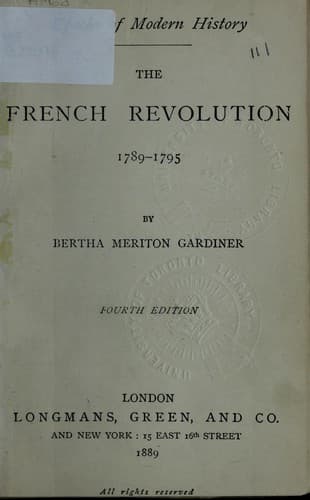
The French Revolution 1789-1795Gardiner, Bertha Meriton
History
The French Revolution 1789-1795
Gardiner, Bertha Meriton
France -- History -- Revolution, 1789-1799
of a church-steeple, could be effected without authorisation from
Paris. Absolute and centralised, the government was also excessively
arbitrary. On plea of State necessity it repudiated debts, broke
contracts, over-ruled laws, and set aside proprietary rights without
scruple. The issue of warrants, called _lettres de cachet_ sealed
letters, ordering the imprisonment of the person designated in some
state fortress, was an ordinary mode of inflicting punishment.
Yet, however harsh and arbitrary in treatment of individuals, the
government sought to avoid collision with the upper classes as a body.
On all sides it left standing institutions of the Middle Ages, local
functionaries, and municipal assemblies, of which the existence in many
instances increased the weight of local charges and impeded attempts to
ameliorate the condition of the working classes. In the same way the
upper law courts, the Parliaments, were suffered as of old to meddle
in administrative matters. Privileges, so far from being assailed,
were respected. Whatever special rights provinces, towns, or classes
possessed were suffered to remain and were often extended.
♦Privileged classes.♦
The wars of Louis XIV. and the orgies of Louis XV. absorbed more and
more money. On the labouring classes, already overtaxed, an increased
weight of taxation was always being laid. Hence, of these classes the
king became the oppressor, and the oppression was the greater because
the upper classes, who were best able to pay taxes, contributed much
less than their fair share of the burden.
Public-domain text, read in full here on John Shaqi.
Reviews
Reviews
No reviews yet
Be the first to share your thoughts on this work.
Join the Discussion
Join the discussion
Sign in to leave a comment or review.
Sign InorCreate an account