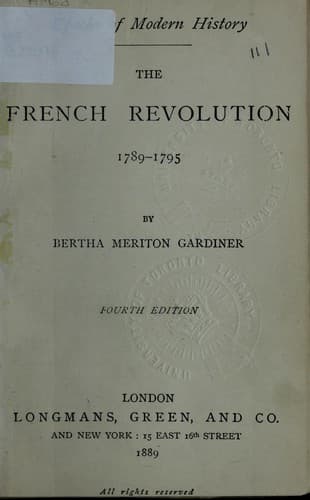
The French Revolution 1789-1795Gardiner, Bertha Meriton
History
The French Revolution 1789-1795
Gardiner, Bertha Meriton
France -- History -- Revolution, 1789-1799
The death of the young Prince was a subject of rejoicing to
Republicans, but served as an additional cause of indignation against
the Convention. The probability of a Royalist insurrection in Paris
was increased by the landing of the emigrants at Quibéron. The
Thermidorians became alarmed for their own safety, and denounced as
Royalists the same journalists and national guards, whose action they
had before the insurrection of Prairial abetted and applauded. But,
since the proscription of the Mountain, they had lost the power of
controlling the Assembly, and the reaction, though impeded by their
resistance, still continued its course.
♦State of the Church.♦
Accepting what had already been done in many parts of the country,
the Convention passed a law sanctioning the provisionary use of
churches for the exercise of worship, but prohibiting any persons from
officiating in them before making a promise of submission to the laws
of the Republic (May 30). At Paris twelve, and subsequently fifteen,
churches were reopened. The oath imposed by the civil constitution of
the clergy was thus abandoned, and, in fact, the civil constitution
itself. Within the limits assigned by this law and the law which had
been passed in February (p. 227), the Church was left at liberty
to effect its own reorganisation. The constitutional Bishops, of
whom the majority had not abdicated, headed by Grégoire, Bishop of
Blois, made every endeavour to recover for the Church its former
influence. The work was accomplished with rapidity. The religious
persecution in itself had tended to destroy the sceptical spirit
which had prevailed amongst the middle classes in 1789, while the
mass of the constitutional clergy were men who had proved themselves
worthy of respect by remaining throughout the Terror faithful to their
convictions. Within a few months the clergy were again exercising
their former functions without obstruction. Internal divisions,
however, remained unhealed. Some of the nonjurors, who had never
taken the oath imposed by the civil constitution, made the promise
of submission to the laws of the Republic, and officiated in public
buildings, but refused to recognise the authority of the former
constitutional Bishops. Others of the nonjurors refused even to promise
submission to the laws, and officiated in secret in barns and private
houses, under constant fear of proscription and death. There were thus
three classes of priests, all at enmity with each other: (1) those who
had taken the oath required in 1790; (2) those who had refused this
oath, but had since promised submission to the laws; (3) the so-called
refractory priests, who had not taken the oath required in 1790, and
now refused submission to the laws. As a rule the lower and middle
classes were attached to the constitutional clergy, while nobles and
Royalists followed the nonjurors. It was in the East, the South, and
the West that the refractory priests had most influence.
♦Constitution of 1795.♦
Public-domain text, read in full here on John Shaqi.
Reviews
Reviews
No reviews yet
Be the first to share your thoughts on this work.
Elsewhere in the archive
Join the Discussion
Join the discussion
Sign in to leave a comment or review.
Sign InorCreate an account