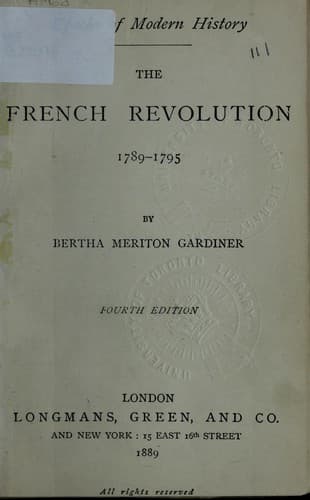
The French Revolution 1789-1795Gardiner, Bertha Meriton
History
The French Revolution 1789-1795
Gardiner, Bertha Meriton
France -- History -- Revolution, 1789-1799
The re-establishment of constitutional government, loudly demanded
by public opinion, was held by the majority in the Convention
itself necessary for the security of the Republic. On one side the
Constitution of 1791 was lauded by the Monarchists; on the other side
the Constitution of 1793, framed by the Mountain after the ejection
of the Girondists, but never put into force, was demanded by the
Jacobins. To the Convention both were unacceptable; the first because
it admitted a king, the second because it appeared impracticable. The
Terror had dissipated faith in the political virtue and intelligence of
the people, and the same men who in 1791 had been the warmest advocates
of decentralization and extreme forms of democratic government, were
now opposed to manhood suffrage, or to giving to local authorities
the opportunity of usurping sovereign powers. The appointment of a
committee to revise the Constitution of 1793 led to the adoption of
what was in reality a new form of government. The Constitution of
the year III., or 1795, was based on the liberal principles of 1789.
It guaranteed individual liberty, liberty of worship, liberty of the
press, and security of property and of person. As in the Constitution
of 1791, a low property qualification was required for voting in
primary assemblies, a higher one for voting in secondary assemblies.
Primary assemblies elected, as hitherto, justices of the peace for
the canton and municipal officers; secondary assemblies elected the
judges of the higher courts, the upper administrative bodies, and
the deputies to the Legislature. The number of administrative and
municipal bodies was greatly reduced. The administration of districts
was entirely abolished. Only communes with a population of over 5,000
retained separate municipalities. Communes of which the population
was below this number, included in any one canton, had a municipality
common to all. To every administrative and municipal body was added a
commissioner, nominated by the Government, whose duty was to see that
the laws were executed. Precaution was taken against the revival of an
authority at Paris rival to the Legislature. Communes of over 100,000
inhabitants were divided into districts, each with a municipality of
its own. Paris had thus twelve municipalities. The Legislative body
was formed of two Houses, a council of five hundred, and a council of
250 Ancients. Both Houses were elected on the same principle, but the
Ancients had to be forty years of age. Both were renewed by a third
of their number yearly. To the five hundred belonged the introduction
of laws; the Ancients had the right of rejecting them. At the head
of the executive was a Directory of five members, selected by the
Ancients out of a list drawn up by the five hundred. These Directors
appointed the ministers, in number six, and ordered the disposition of
the armed forces. They had no veto on legislation, and neither they nor
the ministers might sit in either council.
Public-domain text, read in full here on John Shaqi.
Reviews
Reviews
No reviews yet
Be the first to share your thoughts on this work.
Elsewhere in the archive
Join the Discussion
Join the discussion
Sign in to leave a comment or review.
Sign InorCreate an account