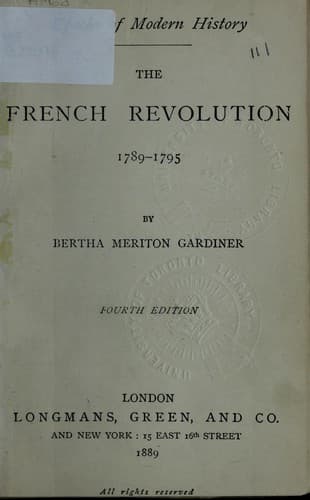
The French Revolution 1789-1795Gardiner, Bertha Meriton
History
The French Revolution 1789-1795
Gardiner, Bertha Meriton
France -- History -- Revolution, 1789-1799
If Louis was unable to forecast the future, so too was the great mass
of his subjects. Amongst the throng of deputies who met together
at Versailles, there was but one, the Marquis of Mirabeau, who
comprehended the real meaning of the revolution, and foresaw with
accuracy the course which events would take. This remarkable man was
endowed by nature with enormous energy, mental and physical. While
still a youth, he had left his mark for good or for ill wherever he
went. He had incurred debts, fought duels, kept order amongst hungry
peasants, eating, drinking, and working with them, obtained the
good-will of men prejudiced against him, and won the hearts of women.
His father, according to the fashion of the time, supported paternal
authority by obtaining _lettres de cachet_ from the government,
ordering the imprisonment of his son. Mirabeau was imprisoned, now in
one fortress, now in another, for months at a time. In early manhood,
at the age of twenty-eight, he entered the donjon of Vincennes, a state
fortress, where he inhabited a dark, barely-furnished room, and had
converse with none but his gaoler. His offences against social order
had not been light, for he had deserted his own wife for the wife of
another man. But in his vices Mirabeau was but a type of the generation
to which he belonged, and the real ground of his imprisonment lay
elsewhere. Books and paper were as a favour allowed him. ‘Without
books,’ he wrote, ‘I should be dead or mad.’ He read and wrote for
fifteen hours out of the twenty-four. After a confinement of more
than three years, the quarrel between him and his father was patched
up. In 1780 he was released, broken in health, harassed by debts, and
blackened in fame, but possessed of a large store of knowledge, a ready
pen, a fluent tongue, and a genius for statesmanship which no man in
France could rival. Genius was, however, no ground for advancement.
A man who had sufficiently powerful interest at court might rise to
the highest dignities in Church or State, whatever his incapacity,
or whatever the stains on his past life. Mirabeau had no interest at
court, while by Louis and his councillors talent was distrusted, and
the one statesman that France possessed occupied the position of an
unscrupulous adventurer, seeking by whatever means came first to hand
to force his way into the ministry. It was no matter of surprise that
so signal a victim of arbitrary government should prove an inveterate
enemy to the existing order. But Mirabeau did not, through resentment
for personal injuries, desire to weaken or degrade the royal authority.
He possessed too strong a capacity for the exercise of power. He saw,
moreover, too directly into the heart of the situation. He comprehended
what no man but himself comprehended at that time, that the real aim
of the French people was the sweeping away of all class distinctions,
and that the monarchy might be immensely strong if only the King could
Public-domain text, read in full here on John Shaqi.
Reviews
Reviews
No reviews yet
Be the first to share your thoughts on this work.
Join the Discussion
Join the discussion
Sign in to leave a comment or review.
Sign InorCreate an account