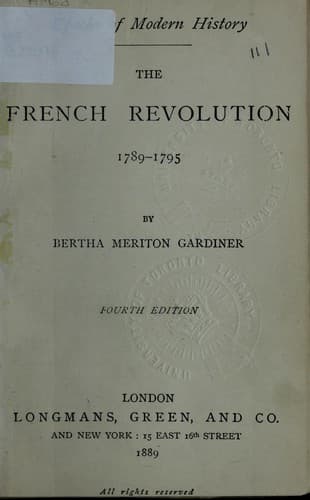
The French Revolution 1789-1795Gardiner, Bertha Meriton
History
The French Revolution 1789-1795
Gardiner, Bertha Meriton
France -- History -- Revolution, 1789-1799
In the chamber thus constituted, a variety of causes often gave
ascendancy to the group which followed Barnave and the Lameths. The
events of June 23 (p. 39) had destroyed confidence in the King, and
though not expressed in words fear always prevailed that Louis would
hereafter use whatever powers were given to him to effect a restoration
of the old order. The reactionary right also refused to work with
the advocates of the system of two chambers, such as Malouet and
Mounier, thus alienating the less democratic members of the centre
and propelling them towards the left. Nobles and ecclesiastics, who
had opposed the union of the three orders, in place of seeking to
establish a constitution based on monarchical principles, made it their
policy to vitiate the Assembly’s work and so increase the elements
of disorder as the surest and speediest means of producing reaction.
Sometimes they abstained from voting or attending debates; sometimes
they interrupted debates; at others they voted with the left against
the constitutional right. The ministry was too feeble and too divided
to exercise influence over the Assembly. It was without the first
requisite for acquiring confidence, a declared and open policy. Necker,
whose principles and aims coincided for the most part with those of
Malouet and Mounier, always received hearty support from them and
their friends. But, proud and irritable, accustomed to command and
not to lead, he did not take advantage of the opportunities which he
had for forming a ministerial party. While devising expedients for
avoiding bankruptcy, he failed even to lay before the Assembly any
complete account of the state of the finances. The reactionary right,
which never forgave him for recommending the double representation
of the Third Estate, and the extreme left, which distrusted him,
concurred in attacking him on every opportunity. His popularity rapidly
decreased, and his position in the ministry grew weak in proportion
as his relations to the Assembly became strained. Mirabeau, the most
powerful man in the house, was his enemy. The mass of deputies, without
trust in the Government and menaced by the right, looked to the people
for support, and through desire of maintaining popularity were the
more ready to adopt measures urged on them by the ultra democratic
press. Their minds were undisturbed, either by the violent language
of Parisian demagogues, or by the existence of riots and bloodshed in
many provinces. The one object that they kept steadily in view was
the establishment of constitutional government on foundations that
should make reaction hopelessly impossible; and compared with this the
restoration of order was to them a matter of secondary importance.
They had no fear of the people. Following the one-sided philosophy of
their day, and leaving out of account the dense ignorance of the lower
classes, the pride and prejudices of the upper, they believed that the
Public-domain text, read in full here on John Shaqi.
Reviews
Reviews
No reviews yet
Be the first to share your thoughts on this work.
Elsewhere in the archive
Join the Discussion
Join the discussion
Sign in to leave a comment or review.
Sign InorCreate an account