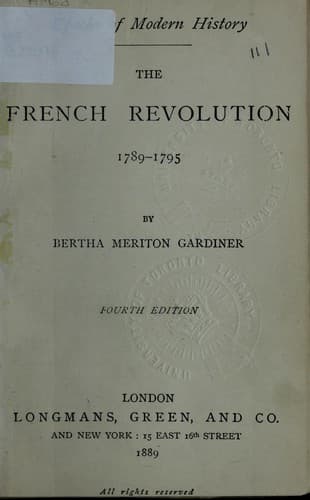
The French Revolution 1789-1795Gardiner, Bertha Meriton
History
The French Revolution 1789-1795
Gardiner, Bertha Meriton
France -- History -- Revolution, 1789-1799
establishment of a free constitution, followed by remedial legislation,
would bring the revolution to an end within the course of a few months,
and render the country law-abiding, prosperous, and contented.
♦Policy of Mirabeau.♦
How vain was this dream, entertained by those with whom he sat
and voted, Mirabeau was well aware. He saw the people ignorant
and credulous, without confidence in the middle class, and ready
to follow the guidance of whoever promised them most; the middle
class unaccustomed to take part in government and divided into
factions, which were united merely by common hatred of aristocratic
institutions. Under such conditions Mirabeau gave small credit to
his countrymen for political capacity, and had no faith in the
endurance of any constitution which cast upon the nation the entire
work of administration and government. But, on the other hand, he did
not seek, like Malouet, to found a strong monarchy on aristocratic
institutions. No real aristocracy existed, and the passion for equality
was irresistible, for the very reason that it was justified by the
incapacity of those classes which had hitherto claimed to rise above
their fellow countrymen. The government which Mirabeau regarded as
alone suited to the requirements of the time was constitutional
monarchy, based on principles of equality and individual liberty,
upheld by the confidence of the middle class, and exercising influence
over the direction of public opinion. Local administration was to be
under the control of the central government; ministers were to have
seats in the legislative body; and the king, in case of difference
between himself and the legislature, was to have the right of refusing
his consent to bills and of appealing by a dissolution to the
constituencies. Mirabeau prophesied that unless the distrust which
the Assembly felt towards Louis were dissipated, the throne would be
overturned by the Parisian populace. His sense of danger quickened
his desire to obtain a place in the council. He had many qualities
fitting him to the task to which he aspired of at once domineering
over Louis, and obtaining a majority in the Assembly to follow his
guidance. He had insight into character, was master of his temper, and
able to inspire men with his own belief, and to fascinate those who
were prejudiced against him. As an orator he was unrivalled. The effect
that he produced on his hearers was so powerful that his very opponents
applauded him. But there were many drawbacks in his way. He came to the
Assembly with an ill reputation that told heavily against him. His life
even now was riotous and profligate, and he was known to be harassed
by debts and unscrupulous in action. His fellow deputies, afraid of
the crown acquiring influence over the Assembly by corruption, even
whilst they were under the spell of his genius, were mistrustful of
his political integrity. Lafayette refused to have dealings with a
man whom he contemned as a libertine.
Public-domain text, read in full here on John Shaqi.
Reviews
Reviews
No reviews yet
Be the first to share your thoughts on this work.
Elsewhere in the archive
Join the Discussion
Join the discussion
Sign in to leave a comment or review.
Sign InorCreate an account