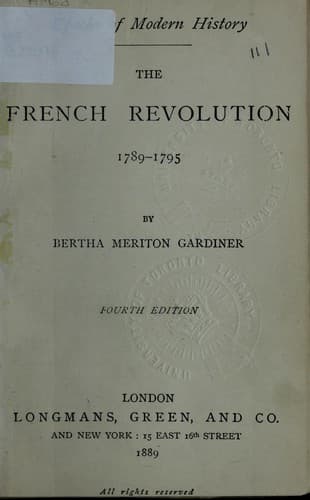
The French Revolution 1789-1795Gardiner, Bertha Meriton
History
The French Revolution 1789-1795
Gardiner, Bertha Meriton
France -- History -- Revolution, 1789-1799
Barnave and the Lameths were
Mirabeau’s rivals for popularity, and jealous of the influence that
his superior eloquence at times allowed him to exercise. On the side
of the Government, which had no chance of surmounting the crisis under
any other guidance, he received no encouragement. Necker feared and
hated him as a dangerous and unprincipled demagogue, and repelled his
overtures; while the aversion of the Queen to all noblemen who took the
popular side was intense. ‘I trust,’ she one day said, ‘we shall never
be reduced to the painful extremity of seeking aid of Mirabeau.’
Thus circumstanced, Mirabeau did his best to weaken and degrade the
Government, expecting that in the course of a few months the King
would be compelled to recognise his claims to office. He never missed
an opportunity of undermining Necker’s popularity, and while defending
with vehemence what he held to be the essential prerogatives of
monarchy, maintained sway over the Assembly and the populace by fierce
attacks directed against the nobles, the clergy, and the court.
♦Declaration of the Rights of Man.♦
The first legislative work of the Assembly after the decrees of August
4 (p. 50), was a Declaration of the rights of man, which, in general
language, stated the aims which the greater part of the Assembly had in
view. This manifesto of the principles of the revolution declared that
men have natural and imprescriptible rights to liberty, property, and
security, and also the right of resisting tyranny; that men are born
equal in rights; that all citizens are equal in the eye of the law,
and are equally admissible to all offices without other distinctions
than those of virtue and talent; that the nation is sovereign, and
that laws are the expression of the general will. In accordance with
these principles, the Declaration announced the abolition of all orders
and corporations, and proclaimed liberty of the press and liberty of
worship.
♦Veto given to the King.♦
Public-domain text, read in full here on John Shaqi.
Reviews
Reviews
No reviews yet
Be the first to share your thoughts on this work.
Elsewhere in the archive
Join the Discussion
Join the discussion
Sign in to leave a comment or review.
Sign InorCreate an account