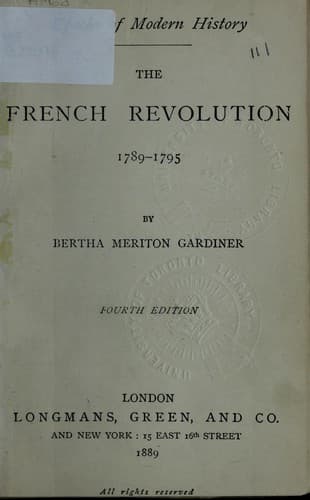
The French Revolution 1789-1795Gardiner, Bertha Meriton
History
The French Revolution 1789-1795
Gardiner, Bertha Meriton
France -- History -- Revolution, 1789-1799
The upper clergy, supported by the nobles, vehemently opposed these
measures, which entirely altered the status of the clergy. The clergy
regarded themselves as administrators of property for Church purposes,
and as independent of state influence; whereas they would henceforth be
brought into close dependence on the state and lose the social position
which wealth and independence gave them. The Abbé Maury accused the
Assembly of interfering with the rights of property, and of being
guilty of an act of spoliation. But the supporters of the new laws
formed an overwhelming majority. Sceptics and theists, Jansenists who
sought to reform the Church in accordance with the primitive usages of
Christianity, lawyers who were merely following the legal traditions
of the old monarchy in arguing that the state interest was paramount,
informed the bishops that the clergy were not proprietors, but merely
administrators of national property, who were justly deprived of a
trust which they had executed ill. By the sale of Church lands the
Assembly designed not merely to restore the finances, but by motives
of self-interest to bind thousands to the work of revolution by
indissoluble ties, since every purchaser of Church lands, every holder
of assignats, every state creditor, would have a direct interest in the
maintenance of the new order.
♦Civil constitution of the clergy.♦
The laws for the appropriation and sale of Church property were
followed by laws for the reform of the Church. Monasteries and
nunneries were suppressed, the existing inmates being pensioned and
left at liberty to return to the world or live in such houses as were
assigned to them. A special code, entitled the ‘Civil Constitution of
the Clergy,’ undertook to carry out in the Church what had been already
done for the state. The old diocesan and parochial divisions were
abandoned. Every department was made a bishopric, and the boundaries of
the parishes were changed according to convenience. Bishops were to be
elected by all the electors of the department, curés by the electors of
each district. Bishops were to signify their election to the Pope, but
not to seek confirmation of their appointments at his hands. Chapters
and ecclesiastical courts were abolished, and in exercising his
functions each bishop was to be assisted by an ecclesiastical council,
composed of chaplains selected amongst the curés of the diocese. The
incomes of bishops were lowered, and those of curés raised. The whole
expense of the establishment was estimated at nearly 3,000,000_l._
♦Federation, July 14, 1790.♦
Public-domain text, read in full here on John Shaqi.
Reviews
Reviews
No reviews yet
Be the first to share your thoughts on this work.
Elsewhere in the archive
Join the Discussion
Join the discussion
Sign in to leave a comment or review.
Sign InorCreate an account