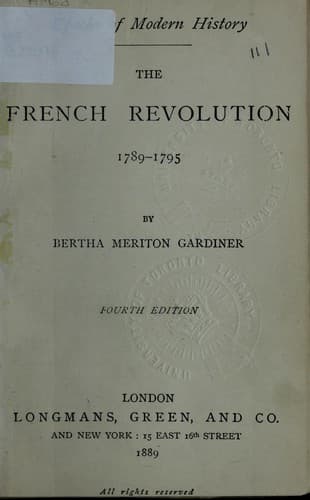
The French Revolution 1789-1795Gardiner, Bertha Meriton
History
The French Revolution 1789-1795
Gardiner, Bertha Meriton
France -- History -- Revolution, 1789-1799
It was only by degrees that these changes were carried out. The
municipalities and other administrative bodies were elected during
the spring of 1790, the new judges not till the autumn, while the
Civil Constitution of the Clergy came into force in the summer of
the same year. An enormous strain was laid upon the patriotism and
intelligence of the country. Active citizens were incessantly called
upon to give time and thought to public affairs, by taking part in
elections and serving in the national guard; while there were more
than a million of unpaid administrative and municipal officers charged
with important duties and great responsibility. All the local business
of the departments devolved on them, the maintenance of roads and
bridges, the police regulations, the care of hospitals, the imposition
and collection of taxes, the sale of national property, and generally
the carrying out of the decrees of the Assembly. Nevertheless, the
country responded with admirable energy. Men believed that a new era
of freedom and prosperity was about to open, and numbers came forward
who unsparingly devoted time and money in discharge of civic duties,
arduous and often dangerous. During the spring all over France the
inhabitants of different villages, towns, and provinces met together
to hold federations, or feasts of union, in honour of the new
constitution. On July 14, the anniversary of the fall of the Bastille,
a federation for the whole of France, at which the King presided, was
held at Paris. Every department sent its deputation of national guards,
who came to the number of 15,000 men. An altar was raised in the middle
of the Champ de Mars, where Talleyrand, Bishop of Autun, said mass, and
blessed the banners of the departments. The thousands assembled swore
with one voice to be faithful to the nation, the law, and the King.
Louis, from his throne, took an oath to maintain the constitution,
and the air resounded with shouts of ‘Long live the King.’ The
Parisians entertained the visitors, and the day closed amid general
lightheartedness and rejoicing. The Bastille was already razed to the
ground, and crowds came to dance on the place where it had stood.
♦The nobles and the revolution.♦
Public-domain text, read in full here on John Shaqi.
Reviews
Reviews
No reviews yet
Be the first to share your thoughts on this work.
Elsewhere in the archive
Join the Discussion
Join the discussion
Sign in to leave a comment or review.
Sign InorCreate an account