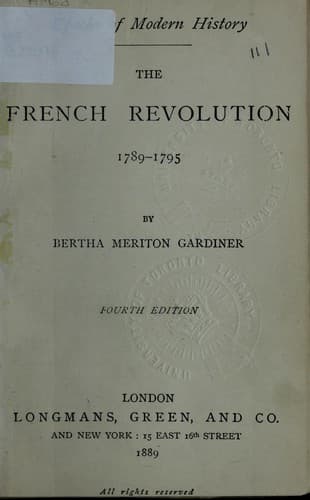
The French Revolution 1789-1795Gardiner, Bertha Meriton
History
The French Revolution 1789-1795
Gardiner, Bertha Meriton
France -- History -- Revolution, 1789-1799
further south in Perigord and Rouergue, in the west in Bretagne, as
well as in the east in Lyonnais, Alsace, Franche-Comté, and Champagne,
peasants and vagabonds went about the country in bands, burning
country-houses and title-deeds, and murdering those who attempted
resistance.
♦Weakness of the Central Government.♦
The central government, whose duty it was to protect life and property,
was impotent even to attempt the restoration of order. The Assembly,
through fear that the King would use authority for the undoing of its
work, had left him without means of enforcing obedience to the laws.
His only agents were the administrative bodies, and he had no means
of compelling them to perform their duties. The highest authority in
reality rested with the administrative bodies which were lowest in the
hierarchical scale--namely, with the municipalities. Of these there
were no less than 44,000, each acting independently of the other,
and though, according to the constitution, bound to carry out the
instructions of the directories of districts and departments, able to
disregard them with impunity. For the maintenance of order a Riot Act
had been passed, but that the King might not take advantage of it for
the suppression of constitutional rights, the municipalities alone had
been empowered to put it in force. Sometimes municipal officers were
unable, sometimes unwilling, to call out the national guard for the
forcible dispersion of rioters. In towns the bourgeoisie served on the
national guard, and there was no want of educated men to hold office.
But in rural districts there were no inhabitants except a few nobles
and curés and an unlettered peasantry. In hundreds of instances the
mayor and his colleagues could neither read nor write, spoke only their
own patois, and were incapable even of understanding the laws that
they were required to enforce. National guards, in place of protecting
the noble and his family from harm, took part with their neighbours
in destroying their dwelling, and in maltreating all whom interest or
prejudice incited them to regard as conspirators against the revolution.
♦Mutinies in the army.♦
Public-domain text, read in full here on John Shaqi.
Reviews
Reviews
No reviews yet
Be the first to share your thoughts on this work.
Elsewhere in the archive
Join the Discussion
Join the discussion
Sign in to leave a comment or review.
Sign InorCreate an account