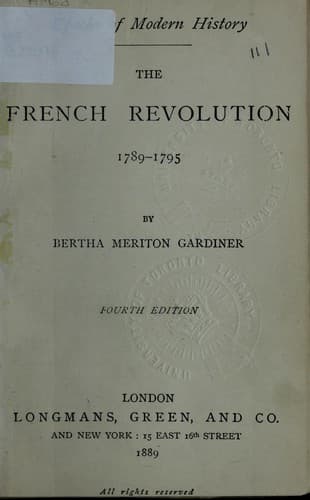
The French Revolution 1789-1795Gardiner, Bertha Meriton
History
The French Revolution 1789-1795
Gardiner, Bertha Meriton
France -- History -- Revolution, 1789-1799
The joy and enthusiasm exhibited at the festival of the federation was
a genuine expression of desire for union entertained by the main and
best part of the population, but this desire rested on no substantial
basis. As the Assembly continued its work divisions multiplied, party
spirit increased in violence, and the country, in place of enjoying
order and settled government, drifted further in the direction of
anarchy. The upper nobility did not conceal its detestation of the
work of the revolution, or its expectation that the whole would
be reversed. Most great nobles left the country, and establishing
themselves at Coblentz or Turin proscribed all who took part in the
revolution, threatened invasion, and called on foreign powers to
restore the King to his rights by force. Those who remained in France
assumed an attitude of scornful defiance, and by protests and intrigues
sought to stir up hatred against the Assembly, and to bring it into
contempt with the country. The lower nobles, if in some way losers,
would have greatly gained by the revolution if it had proceeded no
further; but various causes induced them to declare against it. The
Assembly made no efforts to conciliate them, and a decree abolishing
titles and armorial bearings had deeply hurt the pride of the whole
order (June 9). By many it was held a point of honour to remain true to
their caste; and, in fact, those who gave support to the revolutionary
laws were placed under a social ban. Many nobles quitted the country
with their families, owing to the insecurity of their lives. Those
who were arming on the frontiers brought on all who belonged to their
order the suspicion of being their accomplices. The peasantry needed
no incentive to turn upon the seigneurs. Although the Assembly had
abolished the feudal rights of a servile origin, and those which
represented sovereignty, it maintained, until compensation was made to
the owners, all dues presumed to have had their origin in agreement,
and to represent the price paid for the possession of land. The
arrangement was just, and, if it had been feasible, would have been
of advantage to almost everyone interested. But to effect it a strong
government was required, and France was in the midst of revolution.
The peasants, in whose minds all feudal rights were inextricably bound
up together, refused to recognise legal distinctions between them.
The machinery, moreover, provided by the Assembly for effecting
enfranchisement, in place of being speedy and simple, was complicated
and in many cases practically inoperative. Hence the relations between
peasants and seigneurs, as the revolution advanced, grew more and
more embittered. While the owners of the dues threatened suits, their
debtors resorted to violence. Scenes similar to those witnessed in the
east in 1789 now occurred over a large portion of the country. Again
and again, in 1790 and 1791, in the centre, in La Marche and Limousin,
Public-domain text, read in full here on John Shaqi.
Reviews
Reviews
No reviews yet
Be the first to share your thoughts on this work.
Elsewhere in the archive
Join the Discussion
Join the discussion
Sign in to leave a comment or review.
Sign InorCreate an account