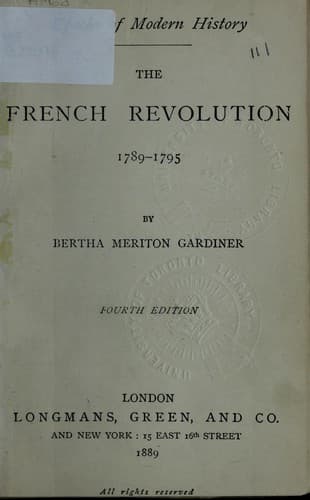
The French Revolution 1789-1795Gardiner, Bertha Meriton
History
The French Revolution 1789-1795
Gardiner, Bertha Meriton
France -- History -- Revolution, 1789-1799
In Camille Desmoulins the levelling principles of the revolution found
their ablest advocate. He belonged to the lower section of the middle
class; and, while speaking in the name of the people, gave expression
to the intense jealousy with which men in his position of life regarded
claims of property or of birth to political or social distinction.
Young, naive, and enthusiastic, Desmoulins was incapable of throwing
dust in his own eyes or in the eyes of others, and from the first
avowed that even the form of monarchical government was incompatible
with the principles that his party held. Since, however, the Assembly
ordained that France was to have a king, he expressed his readiness
to take off his hat when Louis passed by, but he refused to recognise
Marie Antoinette as Queen, and only made mention of her as the King’s
wife. Desmoulins was no precisian like Brissot, and did not concern
himself with the moral disposition of his fellow-countrymen. When
attacking men whom he designated as ‘reactionaries’ and ‘aristocrats,’
without heed of consequences, he made use of every arm which served
his end--irony, calumny, and gross exaggeration. The prevailing state
of anarchy he made light of. Rousseau had said that the people were by
nature merciful and forgiving, and his disciples palliated acts of
ferocity on the score of ignorance and misery. Was it to be expected,
Desmoulins asked, that after centuries of debasement liberty could be
obtained without a little blood-letting?
♦Marat.♦
Marat, a writer of a third type--called, after the title of his
journal, the ‘People’s Friend’--had no faith in any of the distinctive
principles of the time. He did not believe in the goodness of human
nature, nor in reason as the main lever by which to reconstitute
society and government, nor in the political capacity of his
countrymen, and was as ready to throw suspicion on the people’s
nominees as Brissot on the integrity of men put in office by the
King. He did not regard either commercial or individual liberty as
necessarily calculated to increase the happiness and prosperity of
the masses. The goal to which he pointed was a shadowy one of a
democratic state, where mediocrity ruled, and government provided that
the working-classes lacked neither labour nor bread. His means were
the re-establishment of absolute power and the use of force. Since
officials were corrupt, the upper classes seeking power merely for
selfish ends, the people ignorant and easily deceived, Marat proposed
to invest a dictator with authority to establish genuine equality by
crushing under foot the possessors of wealth and talent. As, however,
there appeared no probability of the adoption of this plan, he filled
the pages of his journal with incentives to murder and insurrection,
advising the people to secure their happiness by rising and killing
their enemies in a body. Some thousands of heads laid low, the true era
of freedom and prosperity would open.
Public-domain text, read in full here on John Shaqi.
Reviews
Reviews
No reviews yet
Be the first to share your thoughts on this work.
Elsewhere in the archive
Join the Discussion
Join the discussion
Sign in to leave a comment or review.
Sign InorCreate an account