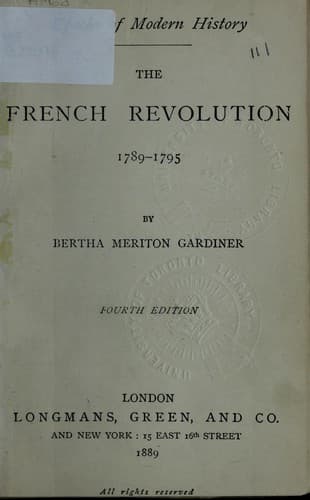
The French Revolution 1789-1795Gardiner, Bertha Meriton
History
The French Revolution 1789-1795
Gardiner, Bertha Meriton
France -- History -- Revolution, 1789-1799
♦Sources of influence of ultra-democrats.♦
Besides Brissot, Desmoulins, and Marat, there were a number of other
writers who in words declared their loyalty to the constitution,
while they excited discontent against it, called in question the
patriotism and good faith of all who did not agree with themselves,
and rendered harder the task of maintaining order. They had different
aims and different views of life, but on certain points they were
all agreed, and for the time the points of agreement alone came into
prominence. With one voice they cast bitter reproaches on the Assembly
for dividing Frenchmen into active and passive citizens, denying the
suffrage to the latter, and excluding them from the national guard.
So, again, they denounced the royal veto on decrees, on the ground
that it subjected the will of the sovereign people to the will of
the king. They condemned the Riot Act, and attacked the Assembly
whenever sanction was given to the employment of military force against
rioters. When the mutiny at Nancy was suppressed in blood, a loud
cry of indignation was raised against Lafayette and other deputies
who on that occasion abandoned the popular side. The ultra-democrats
formed undoubtedly but a minority of the population. The majority of
Frenchmen were content with the constitution, and had no desire to make
more radical changes than those already accomplished. Many causes,
however, enabled the ultra-democrats to exercise influence quite out
of proportion to their numerical strength. It was not merely that
the Government was weak, but also that there was no cohesion between
classes, and that there was no class capable of leading the nation by
obtaining its entire confidence. Suspicion of the nobles was so strong
that they were already nearly in the position of a proscribed class.
The bourgeoisie had not the habit even of administering local affairs,
and was itself regarded with suspicion by the class beneath it. The
people, both ignorant and discontented, regarded those men who were
for the time in office as responsible for their misery. If corn and
bread were dear, the municipal officer who would not lower their price
was denounced as an aristocrat, and his life was threatened. Men of
the middle class, engaged in professional and other pursuits, withdrew
in large numbers from political life. The ultra-democrats, active,
united, and unscrupulous, were therefore able, although a minority, to
put themselves forward as representatives of France, and gradually to
engross the direction of affairs in their own hands.
♦Influence exercised by Jacobin clubs.♦
Public-domain text, read in full here on John Shaqi.
Reviews
Reviews
No reviews yet
Be the first to share your thoughts on this work.
Elsewhere in the archive
Join the Discussion
Join the discussion
Sign in to leave a comment or review.
Sign InorCreate an account