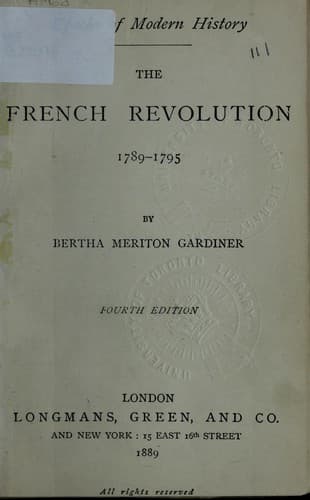
The French Revolution 1789-1795Gardiner, Bertha Meriton
History
The French Revolution 1789-1795
Gardiner, Bertha Meriton
France -- History -- Revolution, 1789-1799
said of the King and Queen, ‘will trample on their corpses.’ In despair
of getting the existing Assembly to repeal its decrees, Mirabeau
advised the King to quit Paris, and after doing all in his power to win
the middle-class to his side to make, if necessary, an appeal to arms.
While, however, he was urging such projects on Louis his naturally
strong constitution, overtaxed by his exertions, broke down, and he
died at the age of forty-two (April 2, 1791). It is wrong to regard
Mirabeau as having been false to his principles because he entered into
a pecuniary transaction with the King. He was a monarchist before 1789,
and he died one in 1791. But the low moral elevation of his character
vitiated his judgment, and increased the difficulties in his path.
By taking money of the King he was precluded from the possibility of
obtaining his confidence. Louis and Marie Antoinette never regarded him
otherwise than as a dangerous demagogue bought over. The distrust in
which his fellow deputies held him was not without justification. He
was quite unscrupulous as to what means he employed to gain his ends,
and did not hesitate to speak words in direct opposition to his real
opinion, nor to support measures which he deemed injurious, in order
to lower the Assembly in the opinion of the country, and increase the
possibility of bringing about a reaction in the royal favour. It is
difficult to doubt that his intense mortification at being excluded
from the ministry made him more ready to countenance the idea of civil
war.
Although long before his death ultra-democrats had accused Mirabeau of
playing a double game, they could not prove the truth of their words,
and to the last the great orator retained his popularity amongst the
people. His remains were interred in the Panthéon, a large church lately
built on the south side of the Seine, which the Assembly had reserved
for the special burial-place of Frenchmen who by their services had
won the honour and gratitude of their country. A vast crowd formed his
funeral procession. A lady, annoyed by the dust, complained of the
municipality for neglecting to water the boulevard. ‘Madam,’ replied a
fishwoman, ‘they reckoned on our tears.’ Whether true or not, the story
bears witness to the feelings of the time.
♦Position of Constitutionalists.♦
Public-domain text, read in full here on John Shaqi.
Reviews
Reviews
No reviews yet
Be the first to share your thoughts on this work.
Elsewhere in the archive
Join the Discussion
Join the discussion
Sign in to leave a comment or review.
Sign InorCreate an account