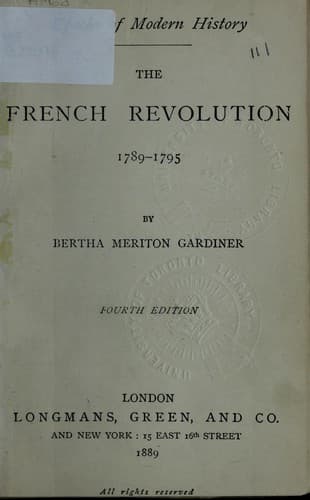
The French Revolution 1789-1795Gardiner, Bertha Meriton
History
The French Revolution 1789-1795
Gardiner, Bertha Meriton
France -- History -- Revolution, 1789-1799
As the revolution thus ran its course, and the ultra democratic
party, with the populace behind it, threatened by its activity and
unscrupulousness in time to make itself entire master of the political
arena, the stronger had become Mirabeau’s desire to enter the ministry
and direct the counsels of the King. From entrance into the council he
was, however, for the time hopelessly debarred. To nip his ambition in
the bud, Necker and his colleagues, shortly after the King’s arrival
in Paris, had instigated the Assembly to decree that no deputy should
be a minister. In the spring of 1790 the King and Queen were induced
to enter into secret communication with the great orator. He tendered
them advice in a written form, and the King in return for his services
made him monthly payments. But Mirabeau soon experienced that except in
trivial matters his advice was never followed. He demanded a far fuller
and more generous acceptance of the principles of the revolution than
it was possible for Louis to give. He accepted as absolute gain, both
for the King and the nation, the fall of the parliaments, the abolition
of privileges, the destruction of the orders of nobles and clergy,
and the freeing of land and labour. Unceasingly he urged and implored
Louis to win the confidence of the nation by turning his back wholly
on the past, and separating the cause of the crown from that of the
upper orders. ‘To accomplish a reaction,’ he wrote, ‘you must destroy
at a blow a whole generation or make blank the memories of twenty-five
millions of men.’ Mirabeau accepted also as the noblest fruits of the
revolution freedom of worship, freedom of the press, and the freedom
of the individual from arbitrary treatment in property and person. But
while detesting government that was arbitrary, or which went astray
through want of means to test public opinion, Mirabeau had little
faith in the wisdom of collective bodies of men, or in the political
intelligence of the middle and lower classes, of whom he believed that,
in the long run, the one would sell political liberty for order, the
other for bread. He, therefore, looked to the King to be the guide and
leader of the nation. His belief was that if only the existing barriers
of distrust were broken down, the middle-class, relieved from fear
of reaction in favour of the nobility and the Church, would readily
assent to the establishment of a strong executive and the repeal of
the decrees making administrative bodies independent of the central
government, and excluding ministers from the legislature. He had,
moreover, the penetration to see that the abolition of aristocratic
institutions, and the parcelling out of the country into equal
divisions, without historical traditions, were measures destructive of
variety and vigour in the national life, and thereby favourable to the
exercise of power by the crown. Unless the course that he advised were
followed he predicted the fall of the throne. ‘The mob,’ he repeatedly
Public-domain text, read in full here on John Shaqi.
Reviews
Reviews
No reviews yet
Be the first to share your thoughts on this work.
Elsewhere in the archive
Join the Discussion
Join the discussion
Sign in to leave a comment or review.
Sign InorCreate an account