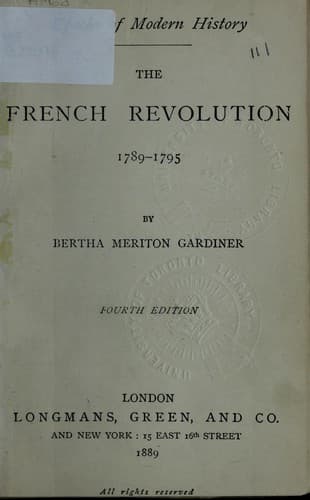
The French Revolution 1789-1795Gardiner, Bertha Meriton
History
The French Revolution 1789-1795
Gardiner, Bertha Meriton
France -- History -- Revolution, 1789-1799
To the King and Queen their position had long since become intolerable.
They regarded the constitution as a monstrous work, based on principles
subversive of all good government. To the laws establishing the
Civil Constitution of the Clergy and imposing an oath on beneficed
ecclesiastics, Louis had given his official consent with reluctance,
but as he was unable to obtain the sanction of the Pope to what he had
done, his peace of conscience was gone. The Queen was greatly suspected
of using her influence to incite her husband against the revolution.
She was intensely unpopular. Up to the middle of the century France
had pursued a policy of opposition to Austria. In 1756 jealousy of
England, and of England’s ally, the rising state of Prussia, had
brought about an offensive and defensive alliance between France and
Austria. The national feeling of hostility had, however, not died out,
and the insignificant part that France took in foreign affairs was
ascribed not to the decadence of the monarchy, but to the Austrian
alliance. To make firm the bond, the partisans of the new system had
accomplished, in 1770, a marriage between Louis, then Dauphin, and
Marie Antoinette, daughter of the Empress Queen, Maria Theresa. Thus,
from her first entrance into the country, Marie Antoinette had been
regarded with disfavour, as the pledge of an unpopular alliance.
Courtiers and intriguers, opposed to the faction which had brought
about her marriage, had accused her of sacrificing French to Austrian
interests, and had bruited false and scandalous tales against her name.
By the revolutionary journalists she was now held up to execration
as the untrue wife and false Queen, the betrayer of France, who was
seeking by aid of Austrian troops to put down the revolution in blood.
Now that trouble had destroyed her love of dissipation and brought
into relief the strong side of her character, Marie Antoinette devoted
all the energy of which her mind was capable to the task of recovering
for her husband and bequeathing to her son the reins of government.
She found her chief pleasure in the fulfilment of her duties as wife
and mother, and by her dignified bearing impressed those who came into
contact with her with a high idea of her daring and intellect. Less
ready, however, than her husband to make concessions, and far more
so to practise deceit, she proved an evil councillor to Louis. Both
desired that the constitution should fail, and regarded the increase
of disorder with indifference, under the idea that suffering would
speedily recall their penitent subjects to the foot of the throne.
Meanwhile, Louis made repeated and public avowals of his satisfaction
with the constitution, intending hereafter to withdraw his words on
the plea that he was not at liberty to express his true opinion. Since
the winter a plan of flight to the eastern frontier was projected, but
its execution was delayed owing to want of money and troops. The Queen
Public-domain text, read in full here on John Shaqi.
Reviews
Reviews
No reviews yet
Be the first to share your thoughts on this work.
Elsewhere in the archive
Join the Discussion
Join the discussion
Sign in to leave a comment or review.
Sign InorCreate an account