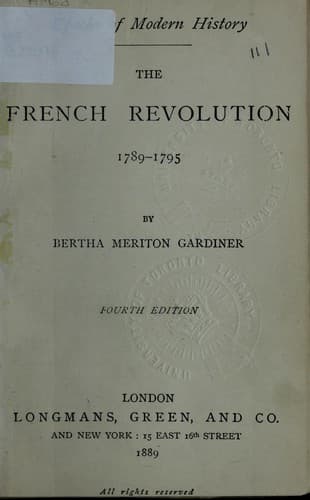
The French Revolution 1789-1795Gardiner, Bertha Meriton
History
The French Revolution 1789-1795
Gardiner, Bertha Meriton
France -- History -- Revolution, 1789-1799
relied on her brother, the Emperor Leopold, to place whatever Austrian
troops were in Luxemburg at her disposal in case of need. She thought
that if the King were once in safety on the frontier, and able to
protect his supporters, a large portion of the nation would rally round
him, and that it would be possible to make a settlement which, while
leaving to the country some form of constitutional government, would
set the royal authority above the heads of all subjects. Rumours that
the King intended flight had for months been floating about. In April,
the national guard, in spite of Lafayette’s remonstrances, detained by
force the royal carriages when on the point of starting for the Palace
of St. Cloud, a short distance outside the city.
The King and Queen had for some time been preparing for flight, though
the day of departure had been from various causes delayed. Servants
who could not be trusted had to be dismissed, and clothes and other
articles forwarded to the frontier ready for use. On the night of
June 20 the King, disguised as a valet, his sister, the Princess
Elizabeth, the Queen, the two children, and their governess, left the
Tuileries unobserved, and were driven in a hackney-carriage a short
distance outside Paris. Here they found ready waiting them a large
new travelling coach, built for the occasion, and three soldiers of
the bodyguard, dressed in yellow liveries, and prepared to act as
couriers. The destination of the royal party was Montmédy, close to
the Luxemburg frontier; and the Marquis of Bouillé, who commanded
in that quarter, had undertaken to station detachments of troops to
guard the way at all the chief towns and villages after Chalons. It
was already two o’clock at night when the coach left Paris behind.
The driver urged on his horses at a quick pace, some eight miles an
hour, and about five o’clock in the afternoon the travellers reached
Chalons-sur-Marne. At this point the most dangerous part of the journey
seemed over. At the next post-house, Pont Sommevesle, Louis expected to
see the first detachment of Bouillé’s troops. On his arrival, a little
after six, he was, however, disappointed. Bouillé had, indeed, with
considerable skill, ordered the passage of troops so that detachments
should be present at all the principal places on the road along which
the royal party was travelling; but unfortunately at each station
those in command lacked either zeal or capacity, or both. Because the
coach was three or four hours behind the time expected, the troops had
already withdrawn from Pont Sommevesle. At St. Menehould, Louis, who
incautiously put his head out of window, was recognised by the master
of the post, Drouet, who observed his likeness to the image of the King
on the assignats. Though not stopped, the coach was pursued by Drouet
and others, whilst the troops present in the town suffered themselves
to be disarmed. About midnight the coach safely reached Varennes, a
little town divided in two by the river Aire.
Public-domain text, read in full here on John Shaqi.
Reviews
Reviews
No reviews yet
Be the first to share your thoughts on this work.
Elsewhere in the archive
Join the Discussion
Join the discussion
Sign in to leave a comment or review.
Sign InorCreate an account