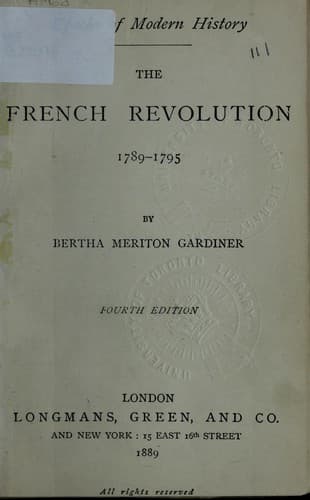
The French Revolution 1789-1795Gardiner, Bertha Meriton
History
The French Revolution 1789-1795
Gardiner, Bertha Meriton
France -- History -- Revolution, 1789-1799
There was, however, small probability that a European congress would
meet; still less that the nation would, without resistance, submit
to foreign interference. Europe was in a disturbed condition. The
great powers had no confidence in one another, nor were they desirous
of acting in union. The empire of which the Queen’s brother was the
head was composed of more than 300 states, greatly varying in size.
The Peace of Westphalia, concluded at the end of the Thirty Years’
War (1648), had assured the princes all the rights of independent and
absolute rulers. Imperial institutions were in decay. The military
organisation of the empire was very defective and inefficient for its
defence. The Diet consisted merely of a few diplomatists, sitting
permanently at Ratisbon, who were representatives of the larger states,
and whom the smaller entrusted with their votes. Under Frederick the
Great (1740–1786) Prussia had developed into a strong power, which
acted as a rival to Austria within the empire. On all important
occasions the larger states followed the lead either of the Emperor
or of the King of Prussia, and between the cabinets of Vienna and
Berlin a bitter antagonism existed. Russia was another state which,
during the past hundred years, had risen into prominence. The Empress
Catherine II. was an able and ambitious woman, who had made use of the
rivalry existing between Prussia and Austria to interfere with effect
in the affairs of Central Europe. Throughout the century, all the great
powers, influenced by ambition and a desire for strengthening their
frontiers, had pursued a policy of territorial aggrandisement. Louis
XIV. had taken from the empire Alsace and Lorraine; Frederick the Great
had torn Silesia from Austria; in 1772, Catherine II., Frederick the
Great, and Maria Theresa together had deprived Poland of some of her
provinces; more recently the Emperor Joseph II., son of Maria Theresa,
had sought to incorporate Bavaria with the Austrian dominions, and
had formed an alliance with Catherine for the spoliation of Turkey.
In 1783 Catherine obtained the Crimea, thus extending her dominions
to the Black Sea. Under this condition of things, the main security
of the weaker states was found in the jealousy existing between the
more powerful. The principle of the balance of power required that
no large alterations should be made in the map of Europe, and that no
one power should make territorial acquisitions unless others obtained
an equivalent. Thus the opposition of Frederick the Great had foiled
Joseph’s project of incorporating Bavaria. It was the traditional
policy of France to support Sweden, Poland, and Turkey against
aggression, and the readiness with which the first partition of Poland
was carried out in 1772 was wholly owing to the decadence into which
the French monarchy had fallen under Louis XV.
♦Europe and the revolution.♦
Public-domain text, read in full here on John Shaqi.
Reviews
Reviews
No reviews yet
Be the first to share your thoughts on this work.
Elsewhere in the archive
Join the Discussion
Join the discussion
Sign in to leave a comment or review.
Sign InorCreate an account