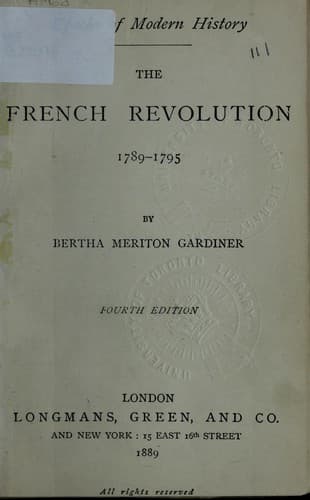
The French Revolution 1789-1795Gardiner, Bertha Meriton
History
The French Revolution 1789-1795
Gardiner, Bertha Meriton
France -- History -- Revolution, 1789-1799
In 1789, when the States-General met, Joseph and Catherine were engaged
in hostilities with Turkey, while England, Holland, and Prussia
threatened to take part in the conflict on behalf of the Porte. This
war in the east, and the possibility of a European conflict diverted
attention from affairs in France. In February 1790, however, the
enterprising and ambitious Joseph II. died; and his brother and
successor, Leopold II., a prince of cool and cautious temperament, made
it his chief object to restore order within his own dominions, more
especially in Hungary and Belgium, which were still in a disturbed
state owing to Joseph’s reforms. To insure Austria against being
attacked by Prussia, he made, in July 1790, a treaty with Frederick
William II., nephew of Frederick the Great, at Reichenbach, and,
to free his hands more completely, entered into negotiations with
Turkey. He had no disposition to attempt the restoration of absolute
monarchy in France. It was the belief of continental statesmen that
where, as in Poland or in England, a constitutional form of monarchy
existed, the executive was necessarily weak and precluded from acting
with vigour or decision in foreign affairs. Hence neither Leopold
nor his chancellor, Kaunitz, took exception to the establishment of
constitutional monarchy in France, which indeed they regarded as a pure
gain to Austria. But after the flight of the royal family to Varennes,
and the manifestation of republican opinions in Paris, foreign princes
began to look on Louis’s cause as the cause of kings, and to dread
lest revolutionary principles, spreading beyond France, should render
their own thrones insecure. Leopold, desirous to aid his sister, sought
the alliance of Frederick William, and made peace with the Porte at
Sistova. A meeting was held between the two allied princes at Pilnitz,
where they signed a declaration expressing their readiness to undertake
armed intervention in French affairs, if other European powers would
unite with them (August 27). Practically this declaration was no more
than a threat. Neither Leopold nor Frederick William contemplated
immediate resource to arms. The English cabinet, directed by Pitt, had
already refused to take part in common action. The alliance between
Austria and Prussia was as yet but loosely knit and was regarded with
distrust by the old school of both Austrian and Prussian statesmen.
Affairs in the east, moreover, called for unremitting attention.
Poland, situated between three powerful and grasping neighbours, was
a prey to perpetual anarchy. The monarchy was elective, and the king
was kept in check by the fierce and seditious nobility by whose votes
he was placed on the throne. The peasantry were downtrodden serfs, and
the middle class without political rights; king and nobles struggling
for power invited foreign interference, and Russia and Prussia by
turns exercised ascendancy at Warsaw. In May 1791, a patriotic party,
Public-domain text, read in full here on John Shaqi.
Reviews
Reviews
No reviews yet
Be the first to share your thoughts on this work.
Elsewhere in the archive
Join the Discussion
Join the discussion
Sign in to leave a comment or review.
Sign InorCreate an account