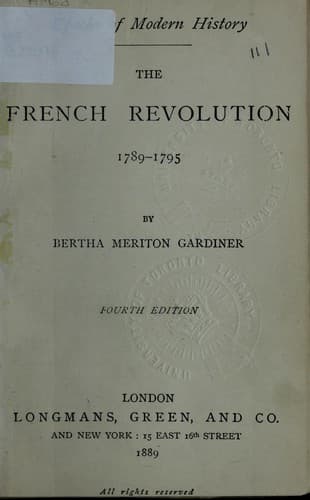
The French Revolution 1789-1795Gardiner, Bertha Meriton
History
The French Revolution 1789-1795
Gardiner, Bertha Meriton
France -- History -- Revolution, 1789-1799
journal became the recognised organ of their party. Their policy was
mainly dictated by a theoretic aversion to monarchical government,
and nervous apprehension of the consequences of Louis’s treachery.
Alive, however, to the fact that public opinion was in favour of the
constitution, they formed no definite plans for its destruction, but
endeavoured to obtain the adoption of measures calculated to reveal the
King’s duplicity, and so to weaken the hold that the throne had upon
the affection of the nation. The body of deputies forming the centre
of the Assembly sincerely desired the maintenance of the constitution,
but had no reliance on the good faith of Louis, and hence oscillated
between the right and the left, being desirous of maintaining the
throne, and yet being afraid to give to the executive a hearty support
or to take strong measures for the suppression of insurrectionary
movements.
♦Ecclesiastical policy.♦
Important questions pressed upon the Legislature for solution. The
ecclesiastical settlement attempted by the constituent Assembly was
being daily proved impracticable. In many cases the administrative
bodies strove hard to preserve the peace and to keep the Churches
open, both to the nonjurors and their rivals; but their efforts were
hopeless. Without a military force always at command it was practically
impossible to maintain both parties in their legal rights. In some
departments the nonjurors set themselves at the head of insurgent
peasants. In others they were subjected to insult and outrage. At Paris
they could celebrate mass only under the protection of national guards.
During the summer of 1791 many administrative bodies, on the plea that
by no other means could order be preserved, prohibited nonjurors from
officiating in parish churches, and required them to reside in the
chief town of the department, away from their former parishioners. The
Legislature had no choice but either to abandon the imposition of the
oath or to follow it out to its logical consequences, and to regard
those who refused to take it as enemies to the existing order. The
last course accorded best with the prejudices of the majority, who
accused the nonjurors of being the sole authors of troubles to which
the situation itself could not fail to give rise. Some on the left
proposed to exile them in a body. The Girondists detested them as the
most bigoted of Catholics. The right weakly sought, on the ground of
religious liberty, to leave matters as they were; but the centre here
voted with the left, and a decree was passed depriving nonjurors of
their pensions, and preventing their officiating in public (November
25). Louis, however, refused his sanction, and the situation remained
unchanged.
♦Foreign policy.♦
Public-domain text, read in full here on John Shaqi.
Reviews
Reviews
No reviews yet
Be the first to share your thoughts on this work.
Elsewhere in the archive
Join the Discussion
Join the discussion
Sign in to leave a comment or review.
Sign InorCreate an account