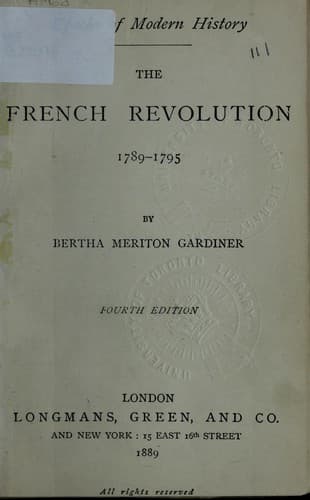
The French Revolution 1789-1795Gardiner, Bertha Meriton
History
The French Revolution 1789-1795
Gardiner, Bertha Meriton
France -- History -- Revolution, 1789-1799
eager to secure national independence by the establishment of a strong
government, obtained the adoption of a new constitution, curtailing the
privileges of the nobles and making the crown hereditary. This measure
at once excited the hostility of Catherine. She gave support to its
opponents, and in order that she might carry out her designs in Poland
undisturbed made peace with Turkey, and sought to stir up a European
war in the west, encouraging the French emigrants, and instigating the
German powers to interfere in their behalf. Catherine’s zeal, however,
rendered Leopold the less willing to involve himself in hostilities,
since events on the Vistula were of much more moment to him than the
details of the French constitution. When, therefore, in September,
Louis agreed to rule in accordance with the constitution, he affected
to regard him as a free agent, and in the hope that the constitutional
party would maintain the upper hand, turned a deaf ear to his sister’s
entreaties that he would obtain the meeting of a European congress.
The King of Prussia entertained a violent hatred of the principles of
the revolution, but Polish affairs and distrust of Austria restrained
him from coming forward as a champion of Louis’s cause. Thus, while
continental princes agreed that the revolutionary tide must be stayed,
nothing was settled as to time and means.
♦The new Legislature.♦
In such a state of foreign affairs the new Legislative Assembly met
(October 1), the only one which ever came together in accordance
with that constitution which had cost so much labour to build up. It
consisted of 740 deputies, who represented exclusively revolutionary
France. There were in it no partisans of the old rule, and no reformers
with aristocratic tendencies. The right side was now composed of
constitutionalists, who held that only by close adherence to the
constitution could the country be safely guided between the double
perils of reaction and anarchy. Though without confidence in the King,
they regarded him as much less powerful for harm than the leaders of
the Parisian populace, and sought on all occasions to maintain him in
the unrestrained exercise of his constitutional prerogatives. The left
of the Assembly, though avowedly constitutionalist, at heart cherished
a desire for the establishment of a more democratic government, and
the abolition of monarchy. A group of men, remarkable for youth,
talent, and eloquence, sat on this side of the house. They were called
Girondists, because their chief orators--Vergniaud, Gensonné, Guadet,
and others who formerly belonged to the bar of Bordeaux--had been
returned by the department of the Gironde. These men were fervent
democrats and republicans, and at the same time defenders of the
principle of individual liberty. They were also sceptics and theists,
inheritors of Voltaire’s passionate scorn and hatred of Catholicism.
Brissot, who now had a seat in the house, belonged to them, and his
Public-domain text, read in full here on John Shaqi.
Reviews
Reviews
No reviews yet
Be the first to share your thoughts on this work.
Elsewhere in the archive
Join the Discussion
Join the discussion
Sign in to leave a comment or review.
Sign InorCreate an account