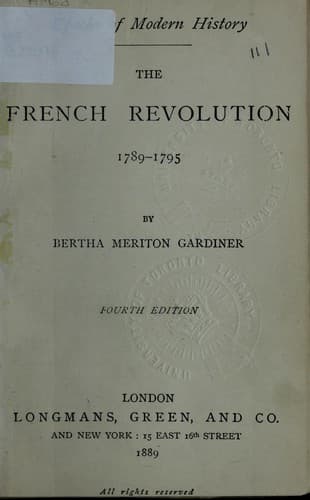
The French Revolution 1789-1795Gardiner, Bertha Meriton
History
The French Revolution 1789-1795
Gardiner, Bertha Meriton
France -- History -- Revolution, 1789-1799
The peril of the country excited on all sides suspicion and distrust,
increasing the bitterness of party strife and threatening to undermine
the standing ground alike of constitutionalists and Girondists.
Girondists as little as constitutionalists had an interest in making
further alterations in the bases of social order. If the Girondists
held more democratic notions of life and government, yet by equality
they understood equality of rights alone, and were to the full as
zealous defenders of the principles of internal free trade and
individual liberty. They were also political purists and precisians,
who, while decrying the aristocracies of birth and wealth, were intent
on founding one of talent and virtue. Hence no sooner had they obtained
possession of the ministries than they came into sharp collision with
whatever members of the ultra-democratic party did not share their
genuine devotion to impracticable ideals. A spirit different from
theirs was by this time rising into prominence amongst the Jacobins.
The saddest result of the long exercise of arbitrary authority is
that it renders mutual confidence impossible. The legacy of the old
system of government to the new France was distrust. Man distrusted
man, and class distrusted class. Thousands of persons who had embarked
in the revolution full of sentimental hope and confidence were now
rushing into the opposite extreme. They had known so little of their
fellow creatures as to imagine that the new equality would be received
with enthusiasm, even by those who had profited the most by the old
inequality; and they now fancied that under every reluctance to accept
the fullest results of the revolution was concealed a deep design
to betray it. A perfect self-confidence easily leads to the most
deep-rooted suspicion; and those who, after the long seclusion from
all participation in practical politics to which most Frenchmen had
been condemned for centuries, were inevitably ignorant how complicated
modern society is, readily imagined all who differed from them to
be traitors to their country. Not only was this suspicion directed
against the King and those of the once privileged orders who remained
in France, but it fastened upon all superiority of station or of
intellect. Many who had been educated in the theories of Rousseau to
believe unreasonably in the purity and intelligence of the masses,
learned no less unreasonably to distrust every man who in any way
rose above the common level, and offered himself with more or less
qualification as a rallying point to the disorganised society around
him.
Public-domain text, read in full here on John Shaqi.
Reviews
Reviews
No reviews yet
Be the first to share your thoughts on this work.
Elsewhere in the archive
Join the Discussion
Join the discussion
Sign in to leave a comment or review.
Sign InorCreate an account