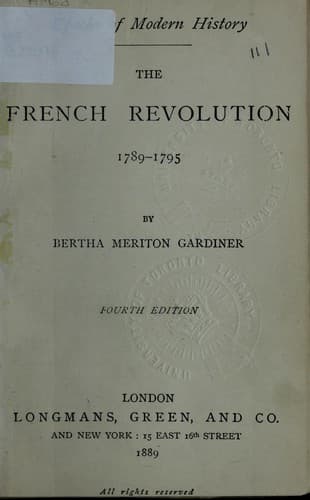
The French Revolution 1789-1795Gardiner, Bertha Meriton
History
The French Revolution 1789-1795
Gardiner, Bertha Meriton
France -- History -- Revolution, 1789-1799
The man who most represented this prevailing distrust of all
superiority would in the end gain for a time that very superiority
which he himself denied to be desirable, but which was required by
the very necessities of human nature. Such a man was Maximilien
Robespierre. A lawyer from Arras, he had been so far influenced by the
teaching of Rousseau as to throw up a lucrative judicial post, lest he
should be compelled to condemn a fellow-creature to death. From such
feelings of pity for the human race to cruelty towards individuals
there is in times of revolution, but a short step. The few who stood
in the way of the entrance of the people into the promised land, where
liberty, equality, and fraternity were to become the accepted rule of
life, soon came to be regarded as monsters of wickedness, whom it was
the duty of every good citizen to sweep away from the earth for very
kindness’ sake. The time for such a proscription had not yet come.
But Robespierre, though he was now excluded from the Legislature, as
having been a member of the last Assembly, was always on the alert in
the Jacobins, ready in dry and acrid tones to draw attention to every
delinquency of those who were struggling to build up authority. The
social and political formulas of Rousseau alone had taken root in his
mind. He cared for equality, and he cared for democracy. For individual
liberty he ceased to care as soon as he found himself in a position to
get the better of his adversaries by resorting to the arms of absolute
and despotic governments. He was certain to be a dangerous and a cruel
opponent. His mind was logical and narrow, he was ambitious and envious
of all above himself, cunning and hypocritical, yet earnest in pursuit
of his aims, incapable of strong affection, of a generous act or a
magnanimous resolution, and wholly devoid of moral sense. Whoever stood
in his light he regarded at once as a personal enemy and a traitor to
the people’s cause. By temperament he was nervous and cautious. He
never set himself at the head of popular movements, always guarded his
statements so as to mean much or little, according to circumstances;
and in case of danger, delayed till the last moment to take a decided
part. Robespierre opposed the war because he divined that both
constitutionalists and Girondists entered upon it with the aim of
obtaining for themselves mastery over France. While the Girondists
accused him of making himself the people’s idol, he accused them of
seeking power for party purposes. In the end he entirely destroyed the
popularity originally enjoyed by Brissot, Guadet, and others in the
Jacobins. The society had become even more democratic in character
since the constitutionalists abandoned it in July 1791. The galleries
were opened to the public, and were ordinarily filled by the most
ardent revolutionists belonging to the lower and lower middle classes.
Of this audience Robespierre won the entire confidence. He put himself
Public-domain text, read in full here on John Shaqi.
Reviews
Reviews
No reviews yet
Be the first to share your thoughts on this work.
Elsewhere in the archive
Join the Discussion
Join the discussion
Sign in to leave a comment or review.
Sign InorCreate an account