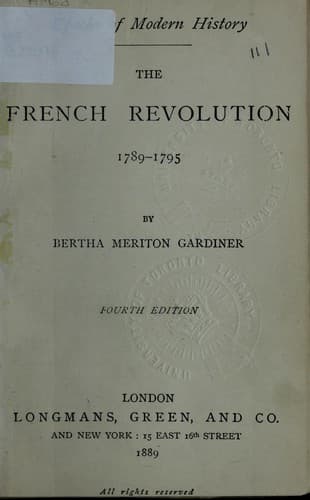
The French Revolution 1789-1795Gardiner, Bertha Meriton
History
The French Revolution 1789-1795
Gardiner, Bertha Meriton
France -- History -- Revolution, 1789-1799
forward as the special representative of the people, whose wisdom
and goodness formed his constant theme. He personified the distrust
felt by the lower classes towards the possessors of rank, wealth, and
talent. He was himself indifferent to the enjoyments that wealth can
give, absolutely incorruptible, an orator without brilliant qualities
of any kind, but in appearance and language always respectable. Behind
Robespierre, frequenters of the Jacobins and joining in the attack on
the Girondists, were Desmoulins and others, to whom the preciseness and
exclusiveness of Roland and Brissot gave offence, besides adventurers
and agitators of the lowest type, whose sole object was to pave the way
for their own advent to power and office. Marat, in his journal, openly
accused the Girondists as well as the constitutionalists of being sold
to the court, and included both in the general proscription which he
unceasingly urged on the people of Paris.
♦Administrative anarchy.♦
The party conflicts waged in the capital were repeated in the
departments. The central government was powerless to impose uniform
action. Roland, the minister of the interior, issued circulars,
inculcating the duty of obedience to the laws, but words were powerless
to restrain the passions which the revolution had let loose. Each
administrative body followed its own course, according as it was
under the dominion of constitutionalist or Girondist opinions. In the
departments round Paris small armies of peasants and brigands, often
with municipal officers at their head, went about fixing a maximum
price of corn and other articles of food. In Languedoc and Guienne
insurgent bands extorted money and pillaged country houses. But nowhere
was administrative anarchy so great and crime so rife as in the four
departments of Gard, Bouches-du-Rhône, Vaucluse, and Lozère, where
reactionary and revolutionary elements came into violent collision.
In Lozère attempts were being made to excite amongst the peasantry
a Catholic reaction, and an armed camp, in communication with the
emigrants, was formed at Jalès. On the other hand, the municipality
at Marseilles, composed of violent ultra-democrats, raised a force
of 4,000 men, and disarmed a Swiss regiment at Aix, and the national
guard of Arles. Avignon, under mob rule, witnessed the commission of
horrible crimes. The Comtat Venaissin had belonged to the Pope since
1273, and Avignon, its chief town, since 1348. After the meeting of
the States-General civil war broke out within this small territory
between the supporters and opponents of revolutionary principles and of
union with France. The constituent Assembly sent mediators who patched
up a peace in January 1791. In September 1791 it at last decreed the
union of Avignon and the Comtat to France. But it had been too late to
prevent the perpetration of the most atrocious deeds. The force raised
by the French party, which had been recruited from the lowest sources,
Public-domain text, read in full here on John Shaqi.
Reviews
Reviews
No reviews yet
Be the first to share your thoughts on this work.
Elsewhere in the archive
Join the Discussion
Join the discussion
Sign in to leave a comment or review.
Sign InorCreate an account