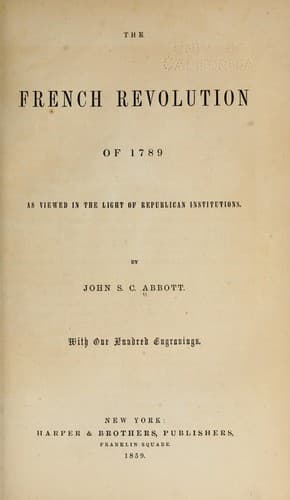
The French Revolution of 1789, as Viewed in the Light of Republican InstitutionsAbbott, John S. C. (John Stevens Cabot)
History
The French Revolution of 1789, as Viewed in the Light of Republican Institutions
Abbott, John S. C. (John Stevens Cabot)
France -- History -- Revolution, 1789-1799
A young man rose in the Assembly, who was unknown to nearly all the
members, and in a calm, distinct, deliberate voice, which arrested
universal attention, said:
"Go, tell your colleagues that we are waiting for them here to aid us
in assuaging the sorrows of the people; tell them no longer to retard
our work; tell them that our resolution is not to be shaken by such a
stratagem as this. If they have sympathy for the poor, let them, as
imitators of their Master, renounce that luxury which consumes the
funds of indigence, dismiss those insolent lackeys who attend them,
sell their gorgeous equipages, and with these superfluities relieve the
perishing. We wait for them here."[105]
The snare was adroitly avoided. There was a universal hum of approval,
and all were inquiring the name of the young deputy. This was the first
public appearance of Maximilian Robespierre.[106]
At last, on the 27th of May, twenty-two days after the convening of the
States, the Commons sent a deputation to the halls of the clergy and of
the nobility, urging them, in the name of the God of peace, to meet in
the hall of the Assembly to deliberate upon the public welfare. This
led to a series of conferences and of suggested compromises from the
king and the court which continued for a fortnight, and all of which
proved unavailing. At last, on the 10th of June, Mirabeau arose, and
said,
"A month is passed.[107] It is time to take a decisive step. A deputy
of Paris has an important motion to make. Let us hear him."
The Abbé Sièyes[108] then rose and proposed to send a last invitation
to the other orders to join them; and, if they refused, to proceed to
business, not as a branch of the convention, but as the whole body. The
proposition was received with enthusiasm. This was on Wednesday. As the
next day, Thursday, was appropriated to religious solemnities, Friday,
the 12th, was fixed upon as the day in which this important summons was
to be sent.[109]
This last appeal was sent in the following words, which the committee
from the Commons were charged to read to the clergy and the nobles, and
a copy of which they were to leave with them:
Public-domain text, read in full here on John Shaqi.
Reviews
Reviews
No reviews yet
Be the first to share your thoughts on this work.
Elsewhere in the archive
Join the Discussion
Join the discussion
Sign in to leave a comment or review.
Sign InorCreate an account