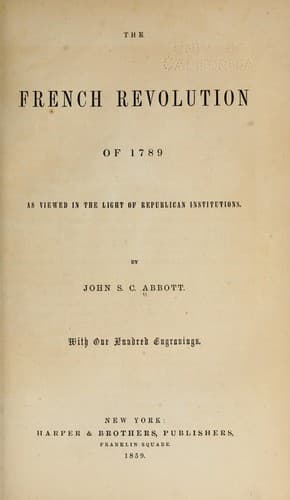
The French Revolution of 1789, as Viewed in the Light of Republican InstitutionsAbbott, John S. C. (John Stevens Cabot)
History
The French Revolution of 1789, as Viewed in the Light of Republican Institutions
Abbott, John S. C. (John Stevens Cabot)
France -- History -- Revolution, 1789-1799
The next day the deputies of the Third Estate at the appointed hour
repaired to the hall; but they found there none either of the clergy or
of the nobles. These two parties, resolved to perpetuate the division
of orders, had met in their respective halls and had organized as
distinct bodies. The Third Estate, assuming the name of the Commons,
abstained from any organic measures and waited to be joined by their
colleagues. Thus matters continued for several days. Every effort was
made on the part of the clergy and nobles to ensnare the Commons into
some measure which would imply their organization as the Third Estate,
but all was in vain. Assuming that they were a meeting of citizens
assembled by legitimate authority to wait for other citizens that they
might organize a political assembly, they merely chose a temporary
chairman for the preservation of order, and _waited_.[103]
Here, then, the vital question was to be decided whether the
States-General should compose one body where the majority should
rule, or three separate bodies where two could unite, a perpetual
majority, against one. Upon this question the whole issue of reform
was suspended. All equally understood the bearings of the question,
and all equally saw that there was no room for compromise. It was a
death-struggle. If united in one assembly the _people_ would have
a majority, and could maintain popular rights. If there were three
bodies the people would be in a hopeless minority, having two against
them. The attention of all France was engrossed by the conflict, and
the nation, with all its interests paralyzed, began to grow impatient
of the delay. "The nobles," M. Bailly writes, "decreed that the
deliberation by order, and the power of each order to put a veto on
the proceedings of the other two, were part of the very constitution
of the monarchy, and that they must maintain them as the defenders of
the throne and freedom. What a strange decree! The representatives of
about two hundred thousand individuals, or more, who are nobles take
upon themselves to decide, and in their own favor, a question that
concerns twenty-five millions of men. They assume for themselves the
right of the veto; they declare the powers and the principles of the
constitution; and who are they more than others who thus declare?"[104]
During this protracted conflict the higher clergy cunningly devised the
following plan to place the Commons in a false position: They sent an
imposing delegation, headed by the Archbishop of Aix, with a pathetic
allusion to the miseries of the people, and entreated the Commons to
enter into a conference to assuage their sufferings. The snare was
shrewdly contrived. If the Commons assented, it was the commencement
of business with three chambers; if they refused, the clergy would
apparently be those alone who regarded the starving population. For a
moment there was much embarrassment.
Public-domain text, read in full here on John Shaqi.
Reviews
Reviews
No reviews yet
Be the first to share your thoughts on this work.
Elsewhere in the archive
Join the Discussion
Join the discussion
Sign in to leave a comment or review.
Sign InorCreate an account