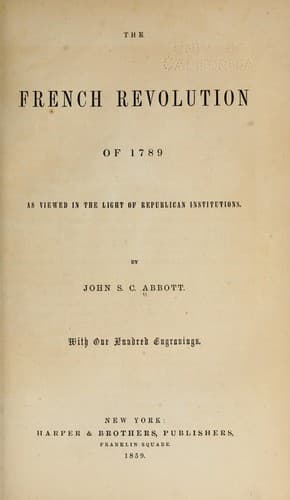
The French Revolution of 1789, as Viewed in the Light of Republican InstitutionsAbbott, John S. C. (John Stevens Cabot)
History
The French Revolution of 1789, as Viewed in the Light of Republican Institutions
Abbott, John S. C. (John Stevens Cabot)
France -- History -- Revolution, 1789-1799
Military detachments patrolled the streets and were posted around the
hall. Four thousand guards were under arms, and there were besides
several regiments in the vicinity of Versailles, within an hour's call.
A tumultuous mass of people from Paris and Versailles surged around
the building and flooded all the adjoining avenues. As the carriage of
the king and queen, surrounded by its military retinue, approached, no
voice of greeting was heard. The multitude looked on silent and gloomy.
The king was exceedingly dejected, for his judgment and heart alike
condemned the measures he had been constrained to adopt. The queen
was appalled by the ominous silence, and began to fear that they had
indeed gone too far. When a few voices shouted "Vive le Duc d'Orleans!"
she correctly interpreted this greeting of her implacable foes as an
intended insult, and was observed to turn pale and almost to faint.
The king entered the hall with the queen, his two brothers, and his
ministers, excepting Necker. The absence of Necker so exclusively
arrested all thoughts, that the royal pageant was disregarded. Here
again the monarch was received in silence, interrupted only by faint
applause from the nobles.
The king hardly knew how to utter the arrogant, defiant words which had
been put into his mouth. It was the lamb attempting to imitate the roar
of the lion. He addressed a few words to the Assembly, and then placed
his declaration in the hands of one of his secretaries to be read.[124]
It declared his intention to maintain the distinction of the three
orders, and that they should vote separately; that they might
occasionally meet together, with the consent of the king, to vote
taxes. The decree of the Commons, constituting a National Assembly,
was pronounced illegal and null. The deputies were forbid to receive
any instructions from their constituents. No spectators were allowed
to be present at the deliberations of the States-General, whether they
met together or in different chambers. No innovation was to be allowed
in the organization of the army. Nobles, and nobles only, were to
be officers. The old feudal privileges were to remain unaltered. No
ecclesiastical reforms were to be allowed, unless sanctioned by the
clergy.[125]
Public-domain text, read in full here on John Shaqi.
Reviews
Reviews
No reviews yet
Be the first to share your thoughts on this work.
Elsewhere in the archive
Join the Discussion
Join the discussion
Sign in to leave a comment or review.
Sign InorCreate an account