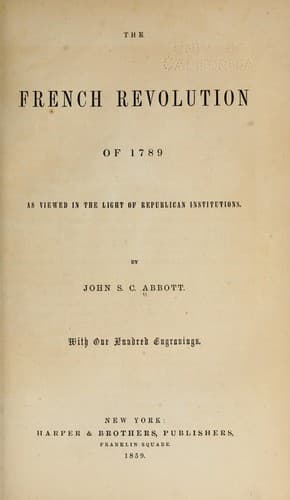
The French Revolution of 1789, as Viewed in the Light of Republican InstitutionsAbbott, John S. C. (John Stevens Cabot)
History
The French Revolution of 1789, as Viewed in the Light of Republican Institutions
Abbott, John S. C. (John Stevens Cabot)
France -- History -- Revolution, 1789-1799
Such were the prohibitions. Then came the benefits. The king promised
to sanction equality of taxation, _whenever the clergy and the nobles
should consent to such taxation_. The king promised to adopt any
measures of finance and expenditure which the States-General should
recommend, if he judged such measures _compatible with the kingly
dignity_. He invited the States--which, be it remembered, were to be
assembled in three chambers, the clergy and the nobility being thus
able to outvote the Commons by two votes to one--to _propose_ measures
for abolishing _lettres de cachet_, measures which should not interfere
with the power of repressing sedition, and of secretly punishing those
whose relatives would be dishonored by their being brought to trial.
They were also invited to seek the means of reconciling liberty of
the press with the respect due to religion and to the honor of the
citizens. In conclusion, the king threatened that if the Commons
refused obedience to these declarations he would immediately dissolve
the States, and again take the reins of government entirely into his
own hands. This address was closed with the following words:
"I command you, gentlemen, immediately to disperse, and to repair
to-morrow morning to the chambers appropriate to your order."[126]
The king then, with his attendant court, left the hall. A large part
of the nobility and nearly all the bishops followed him. Exultation
beamed upon their faces, for they supposed that the National Assembly
was now effectually crushed.
FOOTNOTES:
[Footnote 111: Michelet, vol. i., p. 105.]
[Footnote 112: "The party which professed to be the defender of the
throne spoke with infinite disdain of the authority of the King
of England. To reduce a King of France to the miserable condition
of the British monarch was, in the bare conception, heinous and
treasonable."--_Considerations on the French Revolution, by Madame de
Staël._]
[Footnote 113: Madame de Staël, vol. i., p. 106.]
[Footnote 114: Michelet, vol. i., p. 106.
Public-domain text, read in full here on John Shaqi.
Reviews
Reviews
No reviews yet
Be the first to share your thoughts on this work.
Elsewhere in the archive
Join the Discussion
Join the discussion
Sign in to leave a comment or review.
Sign InorCreate an account