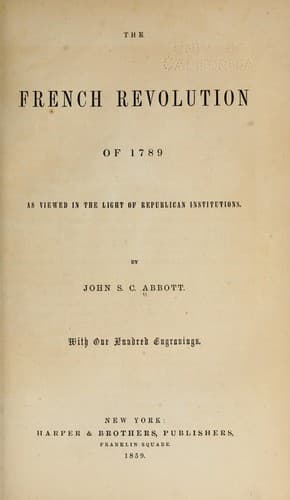
The French Revolution of 1789, as Viewed in the Light of Republican InstitutionsAbbott, John S. C. (John Stevens Cabot)
History
The French Revolution of 1789, as Viewed in the Light of Republican Institutions
Abbott, John S. C. (John Stevens Cabot)
France -- History -- Revolution, 1789-1799
Necker willingly complied with their request.[129] As he left the
palace he informed the multitude that he should remain at his post.
The announcement was received with unbounded demonstrations of joy.
As the exultant shouts of the populace resounded through the castle,
Brézé entered to inform the king that the deputies still continued
their sitting, and asked for orders. The king impatiently walked once
or twice up and down the floor, and then replied hastily, "Very well!
leave them alone."
The next day, Wednesday, June 24th, the Assembly met in its hall and
transacted business as quietly as if there had been no interruption.
The clergy, who had joined them in the Church of St. Louis, still
resolutely continued with them, notwithstanding the prohibition, and
this day one half of the remaining clergy joined the Assembly. A
few individuals from the nobles had also gone over. These two bodies
thus broken were now quite powerless, and were fast sinking into
insignificance. Thousands continually thronged the galleries and the
aisles of the National Assembly, while no one seemed to turn a thought
to the two chambers where the few remaining clergy and the nobles were
separately lingering.
The next day, June 26th, after a long and exciting debate, in which
the overwhelming majority of the nobles resolved to remain firm in
opposition to union, forty-seven of their number, led by the Duke of
Orleans and La Fayette, and embracing many of the most eminent for
talent and virtue, repaired to the Assembly, where they were received
with hearty demonstrations of joy. One of the nobles, Clermont Tonnere,
speaking in behalf of the rest, said,
"We yield to our conscience, but it is with pain that we separate from
our colleagues. We have come to concur in the public regeneration. Each
of us will let you know the degree of activity which his mission allows
him."[130]
The king now wrote a letter to his "faithful clergy" and his "loyal
nobility," urging them to join the Assembly without further? delay. In
compliance with this request, the next day, June 27th, the remaining
portion of the nobility and of the clergy entered the hall and united
with the Third Estate. The Marquis of Ferrières, who was one of the
nobles who at this time united with the Assembly, records,
"It was now a grievous mortification and affliction to the nobility
to join the Third Estate. The Vicomte de Noailles assured the nobles
that the union would be but temporary; that the troops were coming up,
and that in fifteen days every thing would be changed. The king sent a
second letter assuring the nobles that the safety of the state and his
own personal security depended upon the union. The assembly of nobles
rose in a tumultuous manner, they were joined by the minority of the
clergy, and entered in silence the hall of the _Tiers Etat_."
Public-domain text, read in full here on John Shaqi.
Reviews
Reviews
No reviews yet
Be the first to share your thoughts on this work.
Elsewhere in the archive
Join the Discussion
Join the discussion
Sign in to leave a comment or review.
Sign InorCreate an account