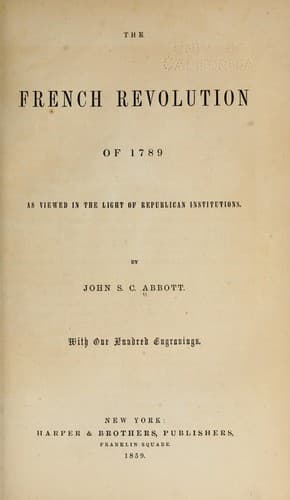
The French Revolution of 1789, as Viewed in the Light of Republican InstitutionsAbbott, John S. C. (John Stevens Cabot)
History
The French Revolution of 1789, as Viewed in the Light of Republican Institutions
Abbott, John S. C. (John Stevens Cabot)
France -- History -- Revolution, 1789-1799
But the nobles and the dignitaries of the Church had hardly entered
the hall of the Assembly ere they regretted the step. The Assembly
was proceeding energetically in the formation of a constitution which
would sweep away abuses. "Many of the nobles," says Ferrières, with
wonderful frankness, "would have quitted the Assembly, but a partial
secession would have done nothing. They were assured that the troops
were coming up, were praised for the resistance they had already made,
and were urged that they must dissemble a little longer. And, indeed,
thirty regiments were now marching upon Paris. The pretext was public
tranquillity; the real object the dissolution of the Assembly." Many
petty artifices were resorted to still to keep up the appearance of
distinct orders. The very day of the junction they endeavored to eject
M. Bailly, a citizen, from the presidency, and to place a clerical
noble, the Cardinal de la Rochefoucault, in the chair. The movement was
promptly checked.[131] They for some time entered in a body after the
openings of the sittings, and stood together, declining to sit down
with the deputies. But M. Bailly, by his prudence and firmness, upheld
the rights of the Assembly, and maintained the dignity of his post.
It was indeed a strange spectacle for France to see a plain citizen,
illustrious only in virtue and talent, presiding over the proudest
nobles and the highest dignitaries of the Church.
The leading members of the Assembly were patriots seeking reform, not
revolution. It was expected that this union would promote harmony.
"How honorable," said Mirabeau, "will it be for France that this great
revolution has cost humanity neither offenses nor crimes." After
describing the sanguinary scenes which accompanied the revolutions
in England and America, he continued, "We, on the contrary, have the
happiness to see a revolution of the same nature brought about by the
mere union of enlightened minds with patriotic intentions. Our battles
are only discussions. Our enemies are only prejudices that may indeed
be pardoned. Our victories, our triumphs, so far from being cruel, will
be blessed by the very conquered themselves.
"History too often records actions which are worthy only of the most
ferocious animals; among whom, at long intervals, we can sometimes
distinguish heroes. There is now reason to hope that we have begun
the history of man, the history of brothers, who, born for mutual
happiness, agree even when they vary, since their objects are the same
and their means only are different."
Public-domain text, read in full here on John Shaqi.
Reviews
Reviews
No reviews yet
Be the first to share your thoughts on this work.
Elsewhere in the archive
Join the Discussion
Join the discussion
Sign in to leave a comment or review.
Sign InorCreate an account