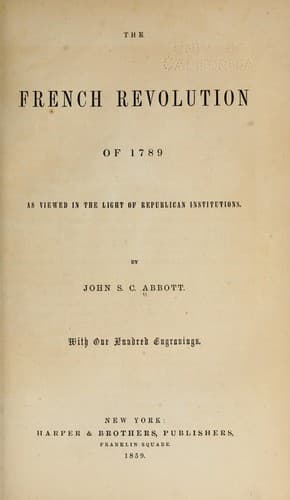
The French Revolution of 1789, as Viewed in the Light of Republican InstitutionsAbbott, John S. C. (John Stevens Cabot)
History
The French Revolution of 1789, as Viewed in the Light of Republican Institutions
Abbott, John S. C. (John Stevens Cabot)
France -- History -- Revolution, 1789-1799
This triumph of the Third Estate exasperated the privileged classes,
and they were eager for revenge. It was evident that their exclusive
power was imperiled, and they resolved, at whatever expense of
bloodshed, to secure the dissolution of the Assembly. It soon became
manifest to all that violence was meditated; that a secret conspiracy
was ripening; that the nobles had united with the Assembly merely to
subserve a momentary purpose, and that the Assembly was to be dispersed
by force, the leaders punished, and that all who should interfere for
their protection were to be shot down.[132]
"I could never ascertain," writes Necker, "to what lengths their
projects really went. There were secrets upon secrets; and I believe
that even the king himself was far from being acquainted with all
of them. What was intended was probably to draw the monarch on,
as circumstances admitted, to measures of which they durst not at
first have spoken to him. With me, above all others, a reserve was
maintained, and reasonably, for my indisposition to every thing of the
kind was decided."
The nobles again became arrogant and defiant. Openly they declared
their intentions to crush the Assembly, and boasted that with an army
of fifty thousand men they would bring the people to terms.[133] Loaded
cannon were already placed opposite the hall, and pointed to the doors
of the Assembly. This state of menace and peril excited the Parisians
to the highest pitch, and united all the citizens high and low to
defend their rights. The French soldiers, who came from the humble
homes of the people, sympathized in all these feelings of their fathers
and brothers. The women, as they met the soldiers in the streets,
would ask, "Will you fire upon your friends to perpetuate the power of
your and our oppressors?" Ere long there came a very decisive response,
"No! we will not." Thus the soldiers who had been collected to overawe
the capital were soon seen in most friendly intercourse with the
citizens, walking with them arm in arm, comprehending the issues which
now agitated the nation, and evidently ready to give their energies to
the defense of the popular cause.
FOOTNOTES:
[Footnote 127: The curate, M. Rabaud de St. Etienne, one of the most
illustrious members of the Assembly, and who finally perished on the
guillotine, writes, "These memorable expressions have been since
engraved upon the bust of Mirabeau which was executed for the society
of _Friends to the Constitution_. A print of this hath been struck off,
in which we behold, not the downcast look of a cunning conspirator, but
the ardent air and attitude of a noble-hearted man, who sincerely meant
the welfare of his country; and such a man was _Mirabeau_."]
Public-domain text, read in full here on John Shaqi.
Reviews
Reviews
No reviews yet
Be the first to share your thoughts on this work.
Elsewhere in the archive
Join the Discussion
Join the discussion
Sign in to leave a comment or review.
Sign InorCreate an account