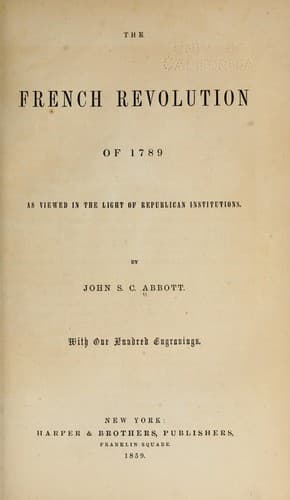
The French Revolution of 1789, as Viewed in the Light of Republican InstitutionsAbbott, John S. C. (John Stevens Cabot)
History
The French Revolution of 1789, as Viewed in the Light of Republican Institutions
Abbott, John S. C. (John Stevens Cabot)
France -- History -- Revolution, 1789-1799
Notwithstanding the National Assembly was thus organized, rumors filled
the air that the junction was but transient, and that the court was
making preparation for some deed of violence. The citizens of Paris
were in a great ferment, all business was at a stand, the poorer
classes had no employment, and their families were actually perishing
from hunger. Troops were continually parading the streets, and an army
of fifty thousand men, now placed under the command of the veteran
Marshal Broglie, encircled the city of Versailles. The spacious garden
of the Palais Royal in Paris, surrounded by the most brilliant shops in
Europe, was the general rendezvous of the populace anxiously watching
the progress of events. The people in their misery had nothing to
do but to meet together to hear the news from Versailles. Often ten
thousand men were assembled in the garden, where impassioned orators
harangued them upon their rights and upon their wrongs. The Duke of
Orleans, with his boundless wealth, encouraged every insurrectionary
movement. He was willing so far to renounce aristocratic privileges as
to adopt a constitution like that of England, if he, as the head of the
popular party, could be placed upon the throne, from which he hoped to
eject his cousin Louis XVI.
It soon became evident that there was a _Tiers Etat_ in the army as
well as in the state. The French Guards, consisting of three thousand
six hundred picked men, in the highest state of discipline and
equipment, were stationed at Paris. They began to echo the murmurs
of the populace. The declaration of the king had informed them that
no reform whatever was to be tolerated in the army; that the common
soldier was to be forever excluded from all promotion. The privates and
subalterns were doomed to endure all the toil of the army and its most
imminent perils, but were to share none of its honors or emoluments.
The troops were governed by young nobles, generally the most dissolute
and ignorant men, who merely exhibited themselves upon the field on
parade days, and who never condescended even to show themselves in the
barracks.
Public-domain text, read in full here on John Shaqi.
Reviews
Reviews
No reviews yet
Be the first to share your thoughts on this work.
Elsewhere in the archive
Join the Discussion
Join the discussion
Sign in to leave a comment or review.
Sign InorCreate an account