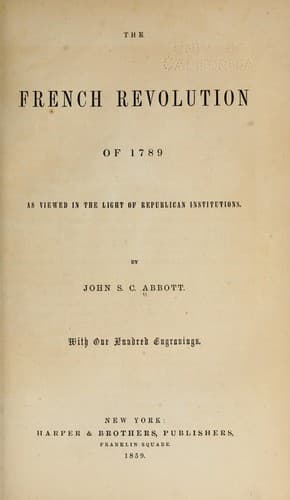
The French Revolution of 1789, as Viewed in the Light of Republican InstitutionsAbbott, John S. C. (John Stevens Cabot)
History
The French Revolution of 1789, as Viewed in the Light of Republican Institutions
Abbott, John S. C. (John Stevens Cabot)
France -- History -- Revolution, 1789-1799
The discontent of the soldiers reached the ears of their officers.
Apprehensive that by association with the people the troops might
become allied to them by a common sympathy, the officers commanded
the guards no longer to go into the streets, and consigned them
to imprisonment in their barracks. This of course increased their
exasperation, and, being left to themselves and with nothing to do,
they held meetings very much like those which they had attended in the
Palais Royal, and talked over their grievances and the state of the
monarchy.[134] Patriotic enthusiasm rapidly gained strength among them,
and they took an oath that they would not fire upon the people. The
colonel of the regiment arrested eleven of the most prominent in this
movement and sent them to the prison of the Abbaye, where they were to
await a court-martial and such punishment as might be their doom. This
was the 30th of June.[135] On the evening of that day, as a vast and
agitated multitude was assembled at the Palais Royal, listening to the
speakers who there, notwithstanding reiterated municipal prohibitions,
gave intelligence of all that was passing at Versailles, tidings came
of the arrest of the soldiers. A young man, M. Lourtalot, editor of a
Parisian paper, mounted a chair and said,
"These are the brave soldiers who have refused to shed the blood of
their fellow-citizens. Let us go and deliver them. To the rescue!"
There was an instantaneous cry, rising from a thousand voices in the
garden and reverberating through the streets, "To the Abbaye!" The
throng poured out of the gate, and, seizing axes and crowbars as they
rushed along, every moment increasing in numbers, soon arrived at the
prison, six thousand strong. There was no force there which could for a
moment resist them. The doors were speedily battered down, the soldiers
liberated and conducted in triumph to the Palais Royal. Here they were
provided with food and lodging, and placed under the protection of a
citizens' guard.
While on their way to the Palais Royal a squadron of cavalry was
ordered to charge upon the people. They approached at full gallop,
and then, regardless of their officers, reined in their horses,
and, lifting their caps, with true French politeness saluted their
citizen-friends. There was then a scene of _fraternization_ such as
the French metropolis alone can exhibit. Men and women ran out from
the houses and the shops presenting to the dragoons goblets of wine,
shouting "Vive le Roi! Vive la Nation!"[136]
Public-domain text, read in full here on John Shaqi.
Reviews
Reviews
No reviews yet
Be the first to share your thoughts on this work.
Elsewhere in the archive
Join the Discussion
Join the discussion
Sign in to leave a comment or review.
Sign InorCreate an account