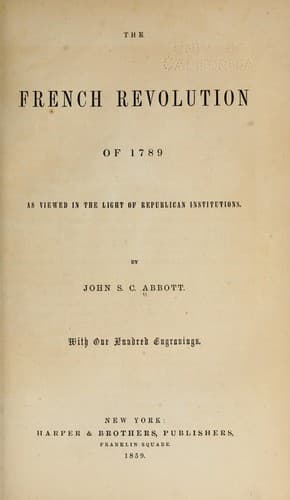
The French Revolution of 1789, as Viewed in the Light of Republican InstitutionsAbbott, John S. C. (John Stevens Cabot)
History
The French Revolution of 1789, as Viewed in the Light of Republican Institutions
Abbott, John S. C. (John Stevens Cabot)
France -- History -- Revolution, 1789-1799
"Citizens! the ministers, the aristocrats, are endeavoring to excite
sedition. Be peaceful, tranquil, submissive to good order. If you
do not disturb the precious harmony now reigning in the National
Assembly, a revolution the most salutary and the most important will be
irrevocably consummated, without causing the nation blood or humanity
tears."
One is bewildered in learning that these sentiments came from the pen
of Jean Paul Marat![140]
The next day, the 2d of July, the king returned an answer to the
deputation from the Assembly, that the soldiers should be pardoned as
soon as order was re-established in the capital. Upon the receipt of
the message at the Palais Royal, the guards were taken back to prison,
from whence they were speedily released by a pardon from the king.
On the 3d of July, M. Bailly having resigned the presidency of the
Assembly, the Archbishop of Vienne, one of the high clergy, who had
warmly espoused the popular cause, was chosen president, and the
Marquis de la Fayette, equally devoted to popular rights, was elected
vice-president. Thus the two most important offices of the Assembly
were conferred upon men selected from the highest ranks of the
privileged class. But this act of conciliation did not in the least
degree conciliate men who were determined at every hazard to perpetuate
despotism.
The aspect of affairs was every hour becoming more threatening. New
regiments of foreigners were continually marching into the metropolis,
and occupying all the avenues which conducted to Paris and Versailles.
Squadrons of horse were galloping through the streets and heavy
artillery rumbling over the pavements of both the cities. The Elysian
Fields, the Place Louis XV., the Field of Mars, presented the aspect
of an encampment. Sentinels were placed around the French Guards,
who were confined in their barracks, to prevent them from holding
any intercourse with the citizens or with the other soldiers.[141]
Versailles was encompassed by armies, and a battery of artillery was
pointed at the very doors of the Assembly.
On Friday, the 10th of July,[142] Mirabeau rose in the Assembly, and
proposed that the discussion of the Constitution should be suspended
while a petition was sent to the king urging the removal of these
menacing armies.
Public-domain text, read in full here on John Shaqi.
Reviews
Reviews
No reviews yet
Be the first to share your thoughts on this work.
Elsewhere in the archive
Join the Discussion
Join the discussion
Sign in to leave a comment or review.
Sign InorCreate an account