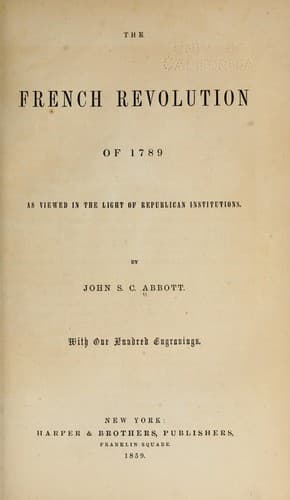
The French Revolution of 1789, as Viewed in the Light of Republican InstitutionsAbbott, John S. C. (John Stevens Cabot)
History
The French Revolution of 1789, as Viewed in the Light of Republican Institutions
Abbott, John S. C. (John Stevens Cabot)
France -- History -- Revolution, 1789-1799
"Fresh troops," said he, "are daily advancing; all communications are
intercepted. All the bridges and promenades are converted into military
posts. Movements, public and secret, hasty orders and counter-orders,
meet all eyes. Soldiers are hastening hither from all quarters.
Thirty-five thousand men are already cantoned in Paris and Versailles.
Twenty thousand more are expected. They are followed by trains of
artillery; spots are marked for batteries; every communication is
secured, every pass is blocked up; our streets, our bridges, our public
walks are converted into military stations. Events of public notoriety,
concealed facts, secret orders, precipitate counter-orders--in a
word, preparations for war strike every eye and fill every heart with
indignation."
At the same time a pamphlet was circulated through Paris, stating
that the king was to hold another royal sitting on the 13th; that he
had determined to enforce his declarations of the 23d of June; that
the National Assembly was to be dissolved by violence, its leaders
arrested, and Necker to be driven from the kingdom.
The tidings excited great consternation in the city, and the crowd
in the Palais Royal began to talk of arming in self-defense. In the
evening of that day an artillery company, which had been posted at the
Hôtel des Invalides, came to the Palais Royal to fraternize with the
people there. The citizens gave them a supper in the Elysian Fields,
where they were joined by many troops from other regiments, and the
friendly festivities were continued late into the hours of the warm
summer night.[143]
This speech of Mirabeau was received with applause, and a deputation
of twenty-four members was sent with a petition to the king. The
address was drawn up by Mirabeau, and is of world-wide celebrity.[144]
"It is not to be dissembled," says Bailly, "that Mirabeau was in the
Assembly its principal force. Nothing could be more grand, more firm,
more worthy of the occasion than this address to the king. The great
quality of Mirabeau was boldness. It was this that fortified his
talents, directed him in the management of them, and developed their
force. Whatever might be his moral character, when he was once elevated
by circumstances he assumed grandeur and purity, and was exalted by his
genius to the full height of courage and virtue."
Though Necker earnestly advised the removal of the troops, the king,
now in the hands of his worst counselors, returned to the Assembly
almost an insulting answer. He affirmed that the troops were mustered
for the maintenance of public order and for the protection of the
Assembly; and that if the members of the Assembly were afraid of their
protectors, they might adjourn to Noyon or to Soissons, cities some
fifty or sixty miles north of Paris, where, removed from the protection
of the capital, they would have been entirely at the mercy of their
enemies.[145]
Public-domain text, read in full here on John Shaqi.
Reviews
Reviews
No reviews yet
Be the first to share your thoughts on this work.
Elsewhere in the archive
Join the Discussion
Join the discussion
Sign in to leave a comment or review.
Sign InorCreate an account