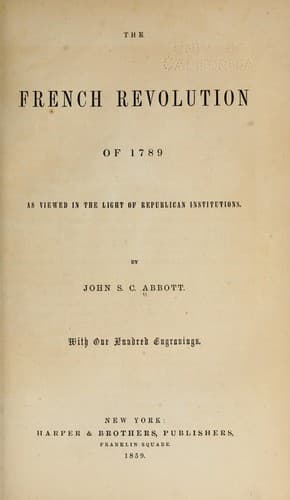
The French Revolution of 1789, as Viewed in the Light of Republican InstitutionsAbbott, John S. C. (John Stevens Cabot)
History
The French Revolution of 1789, as Viewed in the Light of Republican Institutions
Abbott, John S. C. (John Stevens Cabot)
France -- History -- Revolution, 1789-1799
"We have not," Mirabeau indignantly retorted, "asked permission to run
away from the troops, but have requested that the troops may be removed
from the capital."
Upon the reception of this answer from the king, La Fayette presented
the Assembly a declaration of rights based upon that Declaration of
American Independence which is almost the gospel of popular liberty.
It is probable that Thomas Jefferson, who was then in Paris, aided La
Fayette in preparing this paper. It affirmed that nature has made all
men free and equal, that sovereignty resides in the _nation_, and that
no one can claim authority which does not emanate from the people.
On the evening of this day, Saturday, July 11th, as Necker was dressing
for dinner, he received a note announcing his dismissal. A confidential
letter from the king at the same time informed him that the monarch
was unable to prevent his removal, and urged the minister to leave the
kingdom without delay, and not to communicate to any one the knowledge
of his dismissal lest it should excite public disturbance.[146] Necker,
true to the confidence thus reposed in him, quietly dined, and then
taking his carriage, as if for an evening drive with his wife, took
the direction to the Netherlands, the nearest frontier, and pressed on
rapidly through the night.
The next day was the Sabbath, July 12th. Early in the morning an
extraordinary degree of activity was observed among the troops.
Infantry and artillery were marching and countermarching through the
streets of Paris and Versailles. The next day, Monday, was secretly
appointed for the great _coup d'état_, in which the National Assembly
was to be dispersed, and the citizens of Paris, if they manifested any
resistance, were to be mown down by grapeshot. Redoubts were thrown
up upon the heights of Montmartre, where cannon could be placed which
would command the metropolis. Enormous placards were posted, enjoining
the people to remain at home and not to assemble in the streets. The
numerous staff of Marshal Broglie were galloping in all directions,
disgusting the people with their insolent and consequential airs.[147]
A battery of cannon was placed at the Sevres bridge, cutting off all
direct communication between Versailles and Paris. The Place of Louis
XV. was filled with troops, presenting the aspect of an encampment.
In the adjoining Elysian Fields the Swiss Guards, with four pieces of
artillery, were drawn up in battle array.
Public-domain text, read in full here on John Shaqi.
Reviews
Reviews
No reviews yet
Be the first to share your thoughts on this work.
Elsewhere in the archive
Join the Discussion
Join the discussion
Sign in to leave a comment or review.
Sign InorCreate an account